A reusable JSA should save time without turning into boilerplate. The problem starts when the same entries follow the form from job to job: “struck-by,” “use a spotter,” “wear fall protection.” The hazards may be real, but the crew still has to figure out how the exposure could happen, what the control needs to look like, and whether it is actually in place.
That is where a useful JSA earns its value. It should reflect the task, equipment, work area, and conditions the crew is dealing with that day. OSHA’s Job Hazard Analysis guidance takes the same task-specific approach, focusing on the relationship between the worker, the job, the tools, and the work environment.
The six job safety analysis examples below show what that looks like in practice. Each one connects the work step to a specific exposure, a usable control, and a way to verify that control before the job moves forward.
In This Guide
What Makes a Good Job Safety Analysis Example?
A useful JSA follows a simple progression:
Job step > Hazard scenario > Control > Verification
Each part builds on the one before it. Once the job is divided into meaningful steps, the crew can identify how someone could get hurt at each point. That hazard scenario then creates the basis for choosing a control and deciding how the crew will know the control is ready.
Consider this common entry:
Control: Use a spotter.
That may be appropriate, but it leaves several questions unanswered:
- Where will the spotter stand?
- How will the operator and spotter communicate?
- What happens if visual or verbal contact is lost?
The same test applies throughout the examples below: Can the crew tell what needs to be in place before the exposure begins?
If you need the broader process for building a JSA from scratch, Field1st’s job safety analysis template covers the full development process. For the program your JSAs sit inside, see our guide to building a safety management plan.
Not Ready for a Demo?
Why field-level hazard assessments become routine paperwork, what weak hazard assessments cost operations, and how better workflows improve field accountability.
6 Job Safety Analysis Examples You Can Adapt
These are representative examples, not complete safe-work procedures. OSHA’s JHA guidance makes clear that its own sample procedures are illustrative and may not address every step, hazard, or protection required for a particular job.
1. Machine Servicing and Lockout/Tagout JSA Example
What to notice: The JSA identifies where hazardous-energy control enters the job. It does not replace the required procedure.
Under OSHA’s lockout/tagout standard, covered servicing requires hazardous energy to be controlled, including stored or residual energy, and verification of isolation before work begins.
2. Trenching and Excavation JSA Example
What to notice: Excavation conditions can change even when the crew follows the original work sequence.
OSHA’s excavation requirements require competent-person inspections before work and as needed throughout the shift. Additional inspections are required after rainstorms and other hazard-increasing occurrences when employee exposure can reasonably be anticipated.
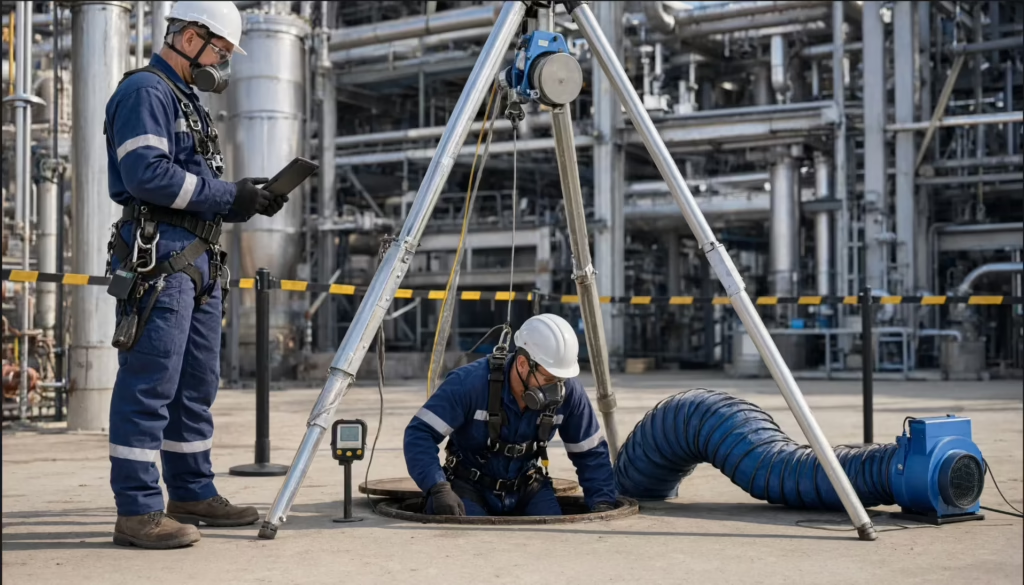
3. Permit-Required Confined Space JSA Example
What to notice: The JSA connects the work to the permit-space process. It does not replace that process.
For general industry permit spaces, 29 CFR 1910.146 establishes requirements for evaluating permit spaces, controlling entry hazards, and maintaining acceptable entry conditions.
4. Forklift Trailer-Loading JSA Example
What to notice: Focus the JSA on the condition the crew needs, not simply the name of a restraint device.
OSHA’s powered industrial truck standard addresses truck and trailer movement during loading and unloading. The applicable restraint method can depend on the vehicle and regulatory context, so the practical field question remains: Is the trailer secured against movement before the forklift enters?
5. Welding and Hot-Work JSA Example
What to notice: Hot-work hazards depend on more than the torch or welder. The surrounding environment changes what controls the job requires.
Under OSHA’s general-industry welding and cutting requirements, fire-prevention measures depend on combustible conditions around the work. PPE, ventilation, and other protections also vary with the nature and location of the operation.
6. Construction Roof-Edge Work JSA Example
What to notice: “Use fall protection” is not enough. The system has to match the construction task and exposure.
OSHA’s construction fall-protection requirements generally require protection at unprotected sides and edges 6 feet or more above a lower level. The standard separately addresses roofing work, holes, skylights, and other situations.
See It on Your Own Job
Bring one real JSA from one real crew. We’ll complete it by voice, flag a hazard from a photo, and show a sub reporting through a QR code.
When Should a JSA Be Updated During the Job?
Getting the analysis right before work starts is only part of the process. The job can move away from the original plan during the shift.
Reassess the JSA when a change affects the hazards, controls, or assumptions behind the original analysis.
Common triggers include:
- A change in scope or work sequence
- Different equipment or tools
- Weather or ground-condition changes
- A new work location
- New contractor or simultaneous-work interfaces
- An unexpected energy source or hazard
- A required control that cannot be established as planned
The excavation example makes this particularly clear. OSHA specifically requires additional inspection after rainstorms and other hazard-increasing occurrences when employee exposure can reasonably be anticipated.
That gives supervisors a useful field test: Does the JSA still describe the work the crew is about to perform, and are the controls that matter most still in place?
Choosing Software for Your JSAs?
Our buyer’s guide compares nine platforms on field capture, offline behavior, contractor access, and published pricing, and says where Field1st doesn’t win.
How Field1st Helps Crews Complete and Update JSAs in the Field
A strong JSA starts with an accurate picture of the job. The challenge is keeping that picture current when crews are working in gloves, moving between tasks, dealing with weak signal, or responding to conditions that were not part of the original plan.
Field1st’s JHA and JSA software is built around that gap between the morning analysis and the work that actually unfolds in the field. Crews can document the job, review hazards and controls, and reassess the analysis when conditions change, while a qualified person retains responsibility for confirming the final calls.
That gives safety teams a more workable way to:
- Capture the job while the details are fresh: Voice1st safety forms let crews talk through JSAs and other safety records while Field1st maps the conversation into the appropriate fields for review.
- Keep the analysis usable when the job changes: Field1st supports dynamic JSAs that can be reassessed against changing scope, weather, crew, and field conditions.
- Keep human judgment in the process: The worker, supervisor, or qualified person reviews and signs the record rather than treating AI output as the final safety decision.
- Keep the workflow moving in zero-signal areas: Voice1st can capture records offline and synchronize them when connectivity returns.
Type II certified
The value isn’t just completing the JSA faster. It is giving crews a practical way to keep the analysis connected to the conditions they are actually working in.
20-Minute Walkthrough
See how Field1st can help your crews build, review, and update JSAs in the field while keeping the final safety decision with the people responsible for the work.
FAQ
Does OSHA Require a JSA for Every Job?
Federal OSHA uses JHA/JSA as a hazard-identification method, but it does not prescribe one universal JSA form for every task. Specific standards may separately require hazard assessments, procedures, permits, inspections, briefings, or other controls depending on the work.
Can I Use These JSA Examples Exactly as Written?
No. Use them to model the work sequence, level of detail, hazard descriptions, controls, and verification points. Then evaluate the actual task, equipment, location, crew, work conditions, company procedures, and applicable requirements before using the JSA in the field.
What’s the Difference Between a JSA and a JHA?
The terms are commonly used for the same task-based hazard-analysis process. OSHA notes that a job hazard analysis may also be referred to as a job safety analysis. Both focus on identifying and controlling hazards associated with the work.
Does a JSA Replace a Permit or Written Safety Procedure?
Generally, no. A JSA may identify that lockout/tagout, confined-space entry, hot-work authorization, excavation inspection, or another control process applies. Where another procedure, permit, inspection, or authorization is required, that process still needs to be completed under the applicable requirement.