INDUSTRY WHITEPAPER · TURNAROUND & MAINTENANCE
A Turnaround Is the Most Dangerous Work of the Year.
Manage Its Safety Like the Schedule.
When a facility's headcount triples or quadruples in days, hundreds of unfamiliar craft workers and subcontractors execute the highest-hazard, non-routine work of the year against an unforgiving clock. This playbook gives safety and operations leaders a five-dimension readiness model to measure whether the surge workforce is on one unified safety process — and whether you can prove safe delivery to the owner.
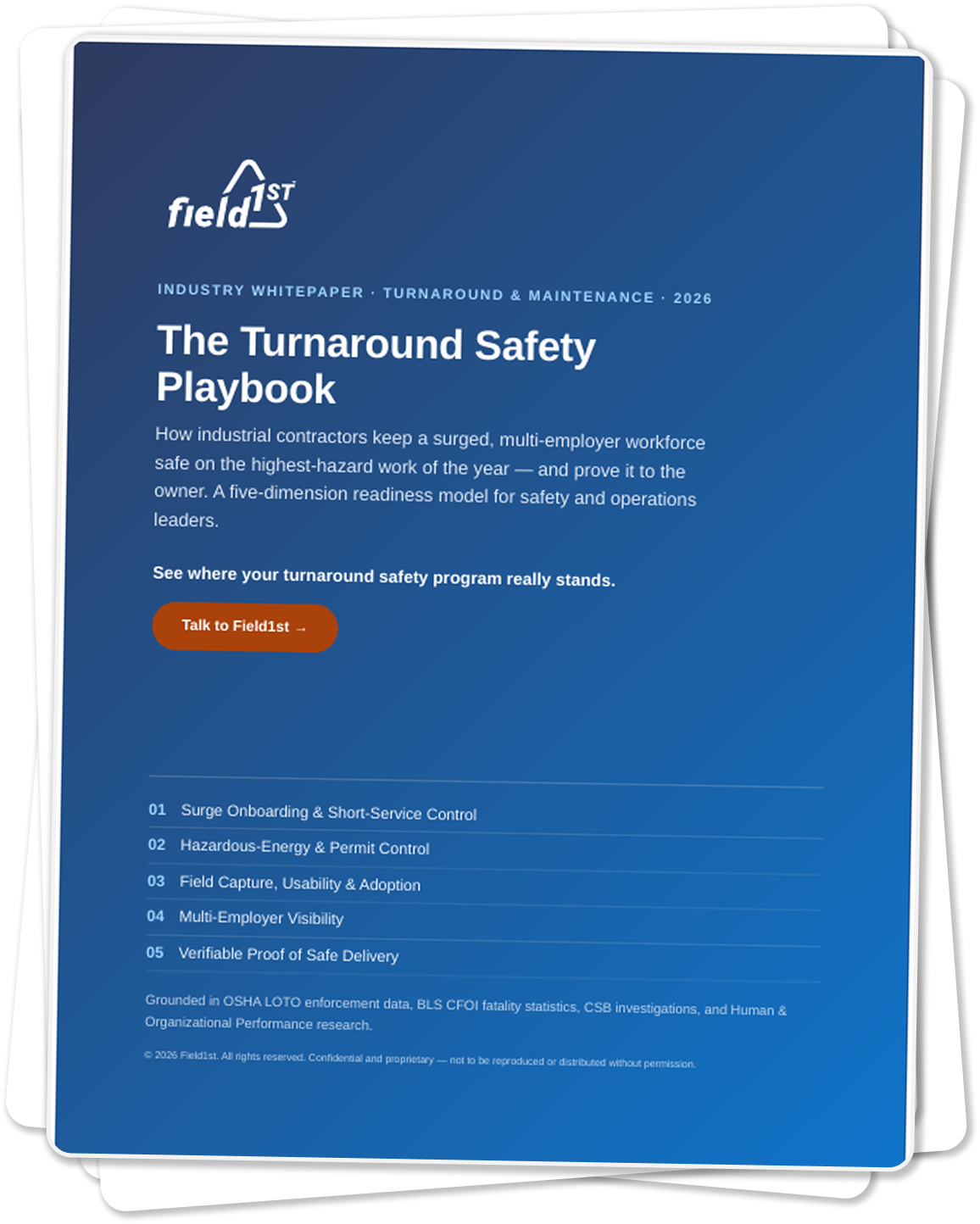
WHAT IS THE TURNAROUND SAFETY PLAYBOOK?
The Turnaround Safety Playbook is a five-dimension readiness model that measures whether an entire surge workforce — every contractor and short-service worker — is operating on one unified, visible safety process during a shutdown, and whether you can prove safe delivery to the facility owner.
Free report · 5-dimension readiness model · Grounded in OSHA, BLS CFOI & CSB investigations.
peak headcount surge when a turnaround mobilizes, often within days.
of refinery and extraction fatalities are borne by contract workers.
workers killed in the BP Texas City turnaround startup — every fatality a contractor.
THE FRACTURE POINTS
The Hazards Aren't Mysterious.
The Coordination Is Where It Breaks.
Turnaround risk is rarely a knowledge problem about the physics of the hazard. It is an execution, visibility, and coordination problem — concentrated among the people least familiar with the site. Legacy corporate safety programs were never architected to absorb a tripling of the workforce in 72 hours, and they quietly fracture at three predictable points.
01
The Onboarding Bottleneck
When hundreds of craft workers and multi-tier subs arrive at once, site induction becomes an operational chokepoint. Under crushing schedule penalties, orientations get truncated and crews are waved on to “finish the paperwork later.” The most dangerous, non-routine work of the year ends up executed by the personnel who received the most superficial safety briefings.
02
Fragmentation of Multi-Employer Data
Every lower-tier subcontractor brings its own JSA templates, protocols, and paper files housed in separate trailers. Without a unified digital repository, the controlling employer can't verify in real time which crews ran adequate hazard analyses or which are working overlapping lines of fire — relegating safety to a reactive posture where hazards surface only after an incident.
03
The Illusion of Paper-Based Control
Under time pressure, paper degrades from a hazard-mitigation tool into a compliance exercise. JSAs get “pencil-whipped” — initialed without engagement or back-filled in the trailer at shift end. A signed permit that doesn't reflect field conditions is more dangerous than none: it creates an illusion of control, and real-time risk is lost exactly when the field is most perilous.
THE TURNAROUND SAFETY READINESS MODEL
Five Dimensions, Scored Where the Surge Happens.
The readiness model scores one vital thing: whether the entire surge workforce is operating under a unified, visible safety process — and whether you can prove it. Evaluate honestly before mobilization; the lowest-scoring field-facing dimension is where the turnaround is most likely to fail catastrophically.
01
Surge Onboarding & Short-Service Control
How fast and how thoroughly is every worker — including transient subs and short-service employees — integrated into one primary safety process?
LEVEL 1 · HIGH RISK
Paper-based orientation creates a bottleneck that gets shortcut under schedule pressure. Short-service employees enter the site effectively blind to specific hazards.
LEVEL 4 · OPTIMIZED
Every worker, including subs and short-service employees, is on one process in minutes by QR and magic link, with no per-seat delay — instant, verifiable integration of the whole surge workforce.
02
Hazardous-Energy & Permit Control
How rigorously are the life-saving controls — LOTO, hot work, confined space — verified at the actual point of work, not just signed in a trailer?
LEVEL 1 · HIGH RISK
Paper permits signed in the trailer with no mechanism to verify field implementation. High likelihood of STKY events from unverified energy isolation and assumed compliance.
LEVEL 4 · OPTIMIZED
Permits and LOTO are enforced in the flow of work, controls confirmed via mandatory photo capture, and escalations visible in real time — building true capacity to fail safely before work begins.
03
Field Capture, Usability & Adoption
Do craft crews legitimately engage with JSAs, permits, and hazard assessments in the field — or is the documentation divorced from real conditions?
LEVEL 1 · HIGH RISK
Paper forms back-filled in the trailer at shift end. Rampant pencil-whipping driven by fatigue and schedule pressure blinds leadership to the true risk profile.
LEVEL 4 · OPTIMIZED
A complete hazard analysis is captured in under 90 seconds by voice and photo, gloves on, offline, and completed on every job — safety that runs at the speed of operations, with rich hazard data.
04
Multi-Employer Visibility
Can site leadership see, in real time, the safety compliance and hazard exposure of every employer working the footprint?
LEVEL 1 · HIGH RISK
Each sub uses its own paper forms; safety managers have zero unified situational awareness. Impossible to coordinate concurrent operations or spot overlapping lines of fire.
LEVEL 4 · OPTIMIZED
Every briefing, hazard, STKY control, and permit across every employer is visible on one real-time dashboard throughout the event — absolute transparency enabling proactive intervention and dynamic resource allocation.
05
Verifiable Proof of Safe Delivery
At project close, how completely and efficiently can you hand the facility owner a defensible record that every control was verified?
LEVEL 1 · HIGH RISK
Records scattered across binders, subcontractor files, and personal devices; assembly is a labor-intensive scramble with unexplainable gaps — real risk of contract loss and legal liability.
LEVEL 4 · OPTIMIZED
Proof-of-completion packets and client dashboards generate automatically from the field data, audit-ready — turning safety compliance into a commercial advantage and guaranteeing defensibility.
Score each dimension Level 1–4 for a total out of 20 — but resist averaging. A Level 4 in closeout proof coupled with a Level 1 in Surge Onboarding still means the highest-hazard days are executed by the least-briefed crews, and that is exactly where turnaround fatalities cluster. Most contractors score highest on backend proof and lowest on surge onboarding and field capture — the two dimensions that directly touch the craft workforce. Your true exposure is your lowest field-facing dimension.
IMPLEMENTATION
Not an Audit.
A 30-Day Pre-Mobilization Blueprint.
You cannot upgrade a safety system mid-turnaround — the operational tempo prohibits introducing friction to a stressed workforce. Deploy the model in the month before the gates open, with the people who actually see the field: operations directors, site supervisors, safety reps, and contractor foremen.
T-30 · ARCHITECT
Define STKY & Configure
Analyze the scope to identify high-energy hazards — critical lifts, confined-space entries, complex LOTO boundaries — and configure digital workflows to require photographic proof of isolation before work proceeds.
T-15 · INTEGRATE
One Process for Every Employer
Mandate frictionless digital onboarding for all lower-tier subs so they connect to the unified dashboard instantly. Verify data flows from the subcontractor tier to the master view without administrative bottlenecks.
T-5 → DAY ZERO · ABSORB
Train Supervisors, Then Surge
Train supervisors on HOP — from compliance monitors to capacity builders. On Day Zero the digital infrastructure absorbs the onboarding shock; leadership watches the dashboard populate and intervenes before a tool touches a pipe.
TURNAROUND SAFETY QUESTIONS
Frequently Asked Questions.
What Is the Turnaround Safety Playbook?
A five-dimension readiness model that measures whether an entire surge workforce — every contractor and short-service worker — is operating on one unified, visible safety process during a shutdown or turnaround, and whether you can prove safe delivery to the facility owner.
Why Are Turnarounds the Most Dangerous Work of the Year?
A turnaround can triple or quadruple site headcount in days, so hundreds of unfamiliar craft workers execute the highest-hazard, non-routine work against an unforgiving schedule. Contract workers bear roughly 74% of refinery and extraction fatalities — and at the BP Texas City turnaround startup, all 15 workers killed were contractors.
What Are the Five Dimensions?
Surge Onboarding & Short-Service Control, Hazardous-Energy & Permit Control, Field Capture / Usability / Adoption, Multi-Employer Visibility, and Verifiable Proof of Safe Delivery. Each is scored Level 1 (High Risk) through Level 4 (Optimized).
What Are HOP and STKY?
HOP is Human & Organizational Performance — shifting supervisors from compliance monitors to builders of the capacity to fail safely. STKY refers to the high-energy hazards most likely to kill (e.g., unverified energy isolation), which the model requires to be controlled and photo-verified before work begins.
How Do We Get Started?
Use the 30-day pre-mobilization blueprint — you cannot upgrade a safety system mid-turnaround. Architect STKY controls at T-30, integrate every employer onto one process at T-15, and train supervisors on HOP at T-5 so the digital infrastructure absorbs the Day-Zero onboarding surge.
Get the Full Playbook. See Where Your Turnaround Really Stands.
The Complete Report, Readiness Scorecard, and 30-Day Pre-Mobilization Blueprint.
Download the full playbook to score your own organization across all five dimensions, or book 20 minutes to walk through how Field1st gets a surged, multi-employer workforce to Level 4 at the point of work.