One contractor submits a JSA. Another arrives with a JHA. Before asking one of them to change forms, a safety manager needs to know whether the names represent different processes or simply different terminology.
OSHA largely treats them as two names for the same type of analysis, referring to “job hazard analyses, also known as job safety analyses.” The practical issue is not choosing the right acronym. It is making sure crews, supervisors, and contractors use the same standard for identifying the work, the exposures, and the controls.
Understanding that distinction helps safety leaders separate company conventions from OSHA requirements and standardize the process around the work being performed rather than the name on the form.
JSA vs JHA: Is There Actually a Difference?
A job safety analysis (JSA) and job hazard analysis (JHA) are generally two names for the same task-level hazard analysis process. In either case, the process is intended to break a job into steps, identify the hazards associated with those steps, and determine how those hazards will be controlled before workers are exposed.
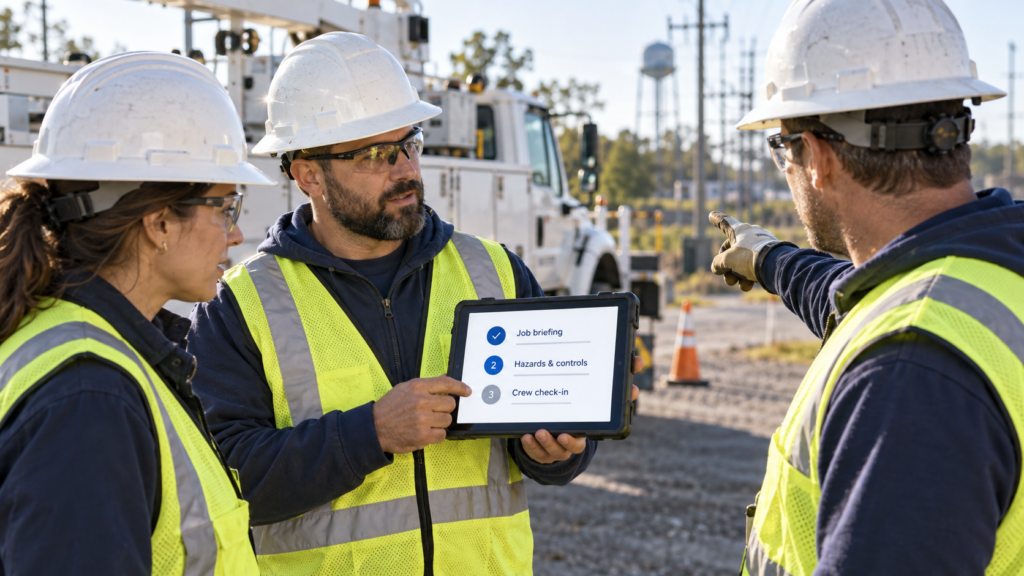
Companies can still define the terms differently within their own programs. An organization might use JHA for a detailed, reusable task analysis and JSA for the crew’s daily pre-task review. Another contractor may use JSA for both. Other employers may use related terms such as pre-task plan, tailboard, or job briefing.
Those conventions can work when the expectations are clear. Confusion starts when crews, contractors, or sites use the terms differently without defining what each analysis is expected to accomplish. A subcontractor may arrive with a document labeled JSA while the general contractor requires a JHA. In that situation, the useful question is whether the analysis meets the requirements established for the work.
What Should a JSA or JHA Actually Do?
With the terminology settled, the quality of the analysis becomes the real issue. A useful JSA or JHA should clearly connect the work being performed to the exposures and controls that apply.
At the task level, the analysis should answer three questions:
- What is the crew doing?
- How could someone be exposed or injured during that step?
- What will prevent or control that exposure?
The difference between a weak and useful entry often comes down to specificity.
| JSA/JHA Element | Weak Entry | Stronger Entry |
|---|---|---|
| Job step | Position equipment | Back equipment into the congested work area |
| Hazard | Struck-by | Workers could enter the backing path while operator visibility is restricted |
| Control | Use spotter | Establish an exclusion area, assign the spotter before movement, confirm the communication method, and stop movement if communication is lost |
The stronger entry gives the crew a specific exposure to control instead of a general hazard label. It also makes it easier to tell whether the control is actually in place before the equipment moves.
Control selection matters, too. The NIOSH hierarchy of controls prioritizes elimination, substitution, and engineering controls ahead of administrative controls and PPE. A JSA or JHA should not default to “follow procedure” or “wear PPE” when a stronger feasible control is available.
For a deeper look at what the document itself should capture, Field1st’s job hazard analysis form guide covers job steps, exposures, controls, responsibilities, and review information.
When Does the JSA vs JHA Distinction Matter in Practice?
Company-Defined Differences
The distinction matters when an organization intentionally gives JSA and JHA different purposes.
For example, a company might use a baseline JHA for a recurring maintenance task, then require the crew to complete a site-specific JSA before starting work. That creates a clear internal distinction between the known hazards of the task and the conditions the crew faces that day.
That distinction is an internal program decision, not a universal OSHA definition. If a company uses the terms differently, safety managers need to define those expectations clearly across crews, contractors, and locations.
What OSHA Actually Requires
The terminology is separate from the question of what OSHA requires. OSHA recommends JHAs/JSAs as part of hazard identification and control, but there is no single blanket federal rule requiring every task to have a document called a JSA or JHA.
Instead, specific standards establish requirements for particular hazards or activities. For example, 29 CFR 1926.21(b)(2) requires construction employers to instruct employees in recognizing and avoiding unsafe conditions. In general industry, 29 CFR 1910.132(d) requires employers to assess the workplace for hazards that may require PPE.
A JSA or JHA may help an employer address those responsibilities, but the form name itself does not establish compliance.
How to Standardize JSA and JHA Use Across Crews and Jobsites
Because companies may use the terms differently, safety teams get more value from standardizing the decision process than simply standardizing the template.
Start by defining what a completed analysis needs to accomplish. Crews and supervisors should know how detailed the job steps need to be, what qualifies as an adequate hazard description, and how specific the controls should be.
The process also needs clear expectations for review and reassessment:
- Who participates in the analysis and reviews it?
- What level of detail is required before work starts?
- What changes trigger a reassessment?
- How are unresolved hazards or corrective actions carried forward?
A reusable JSA may capture the known hazards of a task, but crews still need to compare it with current conditions. Changes in equipment, access, nearby work, weather, or job sequencing can make the original analysis incomplete.
OSHA’s hazard prevention and control guidance specifically recommends reviewing JSAs and JHAs with workers before nonroutine operations. Controls should also be reevaluated when they are not working as intended.
The goal is a consistent standard that crews can apply to the work in front of them, regardless of whether the organization calls the process a JSA or JHA.
How Field1st Supports JSA and JHA Workflows
Standardizing the process is one part of the challenge. Safety teams also need a workable way to carry those expectations across crews and jobsites without losing the connection to what is happening in the field.
Field1st’s safety management platform supports JSA and JHA workflows from initial field capture through review and follow-up:
- Capture the job in the field: Crews can document the task using voice or photos rather than reconstructing the analysis later.
- Keep qualified people in control: AI can assist with drafting hazards and controls, while a qualified person reviews and signs the analysis.
- Work through poor connectivity: Crews can capture records offline and synchronize them when service returns.
- Carry issues into follow-up: Corrective actions can remain connected to the workflow through assignment and closeout.
The result is a more workable way to apply the same JSA/JHA standard across crews and jobsites while keeping the analysis tied to the conditions crews actually face.
See how Field1st helps crews complete, update, and manage JSA and JHA workflows in the field.
FAQ
Does OSHA Call It a JSA or JHA?
OSHA uses both terms. Its current safety-management guidance refers to “job hazard analyses, also known as job safety analyses.” Employers may choose either term or establish their own internal naming convention.
Does OSHA Require a JSA for Every Job?
There is no single federal OSHA rule that universally requires employers to complete a document called a JSA for every task. Specific standards may require hazard assessments, training, job briefings, or other protective measures depending on the work being performed.
Can a Company Use JSA and JHA to Mean Different Things?
Yes. A company can define JSA and JHA differently within its own safety program. If it does, the distinction should be documented and understood across employees, supervisors, sites, and contractors so the terms do not create inconsistent expectations.
When Should a JSA or JHA Be Updated?
Review the analysis when the work no longer matches the conditions it was based on. Changes in scope, equipment, work methods, environment, nearby operations, or newly identified hazards may require the crew to reassess the job and confirm that the controls still fit.