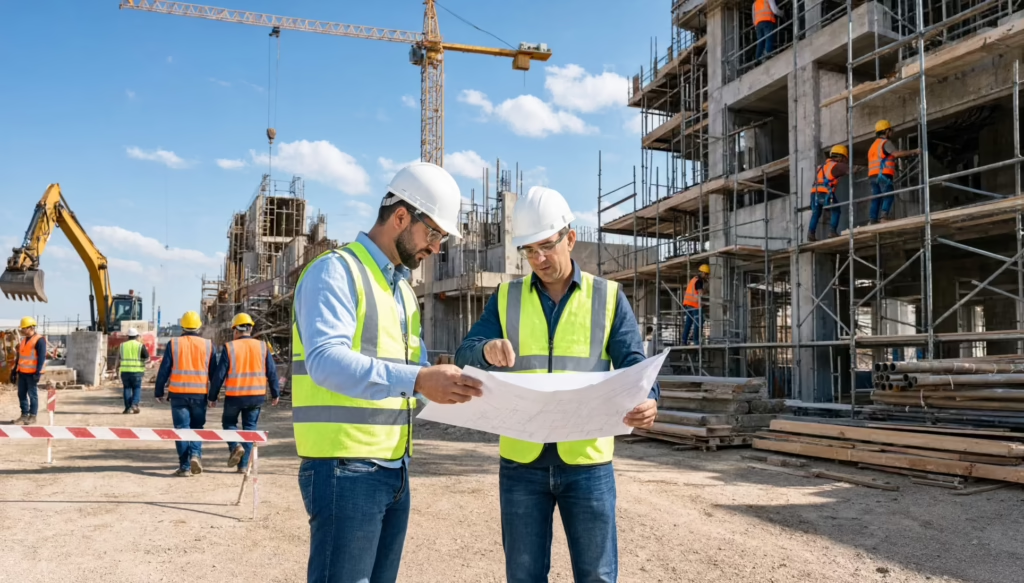
You’ve heard the stories. A hammer falls from two stories up—misses someone by inches. A gas valve leaks but doesn’t ignite. A forklift clips a scaffold, but it doesn’t collapse. These are near misses. And every one of them is a warning you can’t afford to ignore.
Near miss reporting isn’t a checkbox—it’s a frontline strategy. According to Frank Bird’s Safety Triangle, for every fatality or serious injury, there are 10 major incidents, 30 minor ones, and a staggering 600 near misses. That means each unreported close call is a ticking time bomb left unexplored.
The best safety programs treat near misses as gold mines—because each one reveals a crack in the system before it breaks wide open.
In this guide, we’ll break down what near misses are, how to report them effectively, and how tools like Field1st make near miss reporting easy, fast, and part of everyday field operations. If you’re comparing platforms, our breakdown of the best near miss reporting software weighs the leading options side by side.
What is Near Miss Reporting?
A near miss is any unplanned event that didn’t result in injury, illness, or property damage—but easily could have. It’s the moment the stars barely aligned in your favor. No blood was spilled. No gear was destroyed. But it was close. Too close.
These events are often written off with a shrug and a nervous laugh—”That was lucky.” But they’re not just lucky breaks. They’re red flags. And every red flag ignored is an injury waiting to happen.
Here are what they look like in the real-world:
- A steel beam slips from a crane and lands harmlessly on soft soil—but was inches from striking a crew member.
- A worker trips over exposed wiring but regains balance and avoids falling—this time.
- A ladder shifts violently as a gust of wind hits, but no one was on it at the moment.
- A pallet nearly falls off a forklift due to improper stacking but is caught just in time.
- A power tool sparks near a flammable container, but no fire starts.
These aren’t just close calls. They’re clear signs that something in the system isn’t working the way it should—and they deserve attention.
It’s easy to confuse near misses with minor incidents, but the difference is critical:
- Near Miss: Nothing actually happens, but the risk was real. No injury, no damage, just potential.
- Minor Incident: Something did happen—an injury, a broken tool, a property nick—but it was minimal.
The trap? Near misses often get overlooked because they don’t leave a mark. But ignoring them is like seeing smoke and waiting for the fire. Near misses are your early warning system—they tell you where danger lives before it becomes disaster.
Recognizing and reporting near misses is the difference between hoping nothing goes wrong and making sure it doesn’t.
Near Miss vs Incident vs Accident
Understanding the difference between a near miss, an incident, and an accident isn’t just semantics—it’s essential for prioritizing your response, tracking your data correctly, and shaping your safety protocols.
Here’s how they compare:
| Basis | Near Miss | Incident | Accident |
|---|---|---|---|
| Outcome | No injury or damage occurred | Minor injury or equipment damage | Injury, illness, or significant property damage |
| Potential Severity | High — could have led to serious consequences | Medium — resulted in minor issues | High — actual harm or serious consequences occurred |
| Example | A wrench falls from scaffolding and narrowly misses a worker below | Worker trips but regains balance, scrapes knee | Worker falls and breaks a leg |
| Response Required | Internal investigation and preventive action | Minor treatment + Review | Medical response + formal investigation |
| Reporting Requirement | Often underreported, but critical for prevention | Reported internally | Must be reported and documented formally |
Why It Matters:
- Near Misses are the “free warnings” your site gives you. If you collect and analyze them, you’re building a preventative culture.
- Incidents require follow-up but may be brushed off if not tracked consistently.
- Accidents are what everyone wants to avoid—and the pain, cost, and chaos they bring is often preventable if earlier warnings were taken seriously.
Treat all three seriously. But treat near misses as your most valuable feedback loop.
Why Near Miss Reporting Is Crucial for Workplace Safety
Near misses are more than close calls, they’re your early warning system. In this section, we’ll break down why reporting them is mission-critical for preventing accidents, improving safety culture, and staying ahead of costly incidents before they strike.
Helps Identify Hidden Hazards Before They Cause Harm
Every near miss is a free lesson—an early warning system. It’s the moment where something almost went wrong, but didn’t. That’s where the gold is. Each one reveals cracks in the system: a slippery floor, a missing guardrail, a distraction that nearly turned deadly. Ignoring them is like ignoring smoke in a building—you might be safe for now, but the fire’s coming. Near miss reporting gives you visibility before things spiral.
Enables Data-Driven Safety Improvements
You can’t improve what you don’t track. When near misses are reported consistently, patterns begin to emerge: repeated slips in the same hallway, recurring equipment faults, or training gaps tied to specific crews. These aren’t just one-offs—they’re signals. They tell you where to focus, what to fix, and where to invest. And the sooner you catch them, the more preventable the next incident becomes.
Builds a Proactive Safety Culture
A crew that reports near misses isn’t just doing their job—they’re owning the jobsite. It shows they’re paying attention, thinking ahead, and protecting their teammates. That kind of mindset is contagious. It transforms safety from a box to check into something crews actively drive. And when workers see that leadership listens and acts on those reports, trust skyrockets.
Reduces Future Incidents and Costs
The financial math is simple: reacting to an incident costs thousands. Preventing it through a near miss report? Practically free. Studies show the average serious workplace injury costs $42,000 in direct expenses alone. Near miss reporting stops the bleeding before it starts, saving you from lost time, insurance hikes, and legal headaches that snowball fast.
Supports Regulatory and Compliance Readiness
Even when it’s not required, near miss reporting is a green flag to OSHA, MSHA, and other regulators. It proves your safety program is proactive, structured, and continuously improving. In audits or investigations, being able to show logged near misses, follow-up actions, and trends over time is a major credibility boost—and a strong defense against penalties.
With a digital platform like Field1st, near miss reporting happens in seconds, not days. Crews can use mobile prompts for safety incident reporting on the spot, with photo uploads, voice memos, and automatic escalation. No forms, no friction, no excuses. You get real-time insights, audit-ready documentation, and a safer site—without chasing paperwork.
What to Include in a Near Miss Report
When a near miss happens, it’s a rare chance to diagnose a system failure without the consequences. But only if you collect the right details. A strong near miss report paints a clear picture of what almost went wrong—and how close you came to disaster.
Here’s what should be included in every near miss report:
1. Date, Time, and Location
Start with the basics: when and where did the event take place? Was it during the morning rush, in a specific zone, or under certain environmental conditions? These details help identify location-specific hazards or time-based patterns (like increased risk during shift changes or bad weather).
2. Detailed Description of the Event
What was happening before, during, and after the near miss? Don’t just write “almost tripped”—give the full context. Was the worker carrying materials? Was the ground slick? Was visibility poor? The more descriptive the account, the easier it is to pinpoint the failure point.
3. Individuals Involved (Optional for Anonymous Reports)
Who witnessed it or was nearby? If the report is anonymous, that’s fine—but when names are available, it helps safety leads follow up with direct observations or further questions. First-hand perspectives are gold in incident prevention.
4. Potential Consequences
This is where you spell out the close call. What almost happened? Would someone have been injured? Could equipment have been destroyed? Could it have triggered a chain reaction? This helps prioritize the severity of the risk and response timeline.
5. Possible Root Causes or Contributing Factors
Start asking why: Was equipment left out of place? Was a process skipped? Was the lighting poor? Was someone rushing or fatigued? The more root clues you collect, the closer you get to eliminating the real problem, not just patching symptoms.
6. Immediate Actions Taken
What was done right after the near miss? Did someone alert a supervisor? Was the task paused? Was the area blocked off? Immediate response actions help contain risks and show how engaged your crew is.
7. Suggested Corrective Actions
What would fix this? Sometimes the people closest to the problem have the best solutions. Whether it’s clearer signage, better lighting, or a change in layout, encourage the reporter to make suggestions. It shows ownership—and often sparks real fixes.
8. Photos or Evidence (If Available)
Snap and upload. Whether it’s a cracked plank, a cluttered walkway, or a foggy face shield, photos tell the story better than words. It also removes ambiguity and helps leadership or inspectors verify conditions quickly.
9. Reporter’s Name and Role (Optional)
It’s okay to keep things anonymous, but attaching a name and role often leads to faster follow-up and more context. It also encourages recognition for employees who are actively contributing to safety.
With Field1st, every near miss report is structured, digital, and mobile-ready. Crews log events from the field in under 60 seconds—with built-in prompts, photo uploads, and automatic alerts. Everything syncs to a central dashboard, so safety leads see the big picture across jobsites instantly. No more chasing paperwork. No more blind spots. Just clean, clear data—every time.
6 Steps to Near Miss Reporting
Building a near miss reporting system that actually works takes more than a form—it takes a strategy. Here’s a step-by-step breakdown that turns your jobsite into a proactive safety machine:
Step 1: Define What Counts as a Near Miss
Start by aligning your team on the definition. A near miss is not a minor problem, a complaint, or something to shrug off—it’s an event where harm almost occurred. It might not leave a bruise, but it leaves a signal. If you don’t define it clearly, crews won’t know what to report.
Pro Tip: Give examples during toolbox talks. Show video clips. Point to real scenarios on-site.
Step 2: Foster a No-Blame Reporting Culture
If workers think they’ll get in trouble for speaking up, they’ll stay silent—and that silence breeds risk. Make it clear that near miss reporting is not about fault, it’s about foresight.
Celebrate reports, even ones that highlight system flaws. Protect the crew. Praise the proactive.
Message to Send: Reporting a near miss means you’re paying attention. That’s leadership.
Step 3: Make It Easy to Report
Complex forms and outdated processes kill reporting on the spot. The more steps it takes, the less likely it is to happen. Workers need something mobile, intuitive, and fast—something they can use between tasks or mid-shift.
Field1st Bonus: Tap and go. Workers open the Field1st app, log the near miss in 30 seconds, add a photo or voice note, and get back to the job. Zero friction. Full visibility.

Step 4: Review and Investigate Each Report
A near miss report that vanishes into a digital abyss is worse than not reporting at all—it signals to your crew that speaking up was a waste of time. Every report, no matter how small, deserves attention. Start with a short investigation:
- What exactly triggered the event?
- Has something like this happened before?
- Was it a one-off occurrence or part of a bigger pattern?
Loop in the supervisor or safety lead, gather a few first-hand details, and document any contributing factors. Then assign corrective actions with due dates. And here’s the kicker—follow through. Nothing erodes trust faster than an unclosed loop.
Step 5: Track Trends and Leading Indicators
If you’re not tracking near misses, you’re missing your biggest warning signs. One near miss might seem like a fluke. But when similar events pile up in the same spot, on the same shift, or around the same task—that’s no coincidence. That’s a fault line forming.
You need to look beyond the individual report and start asking:
- Where are these happening?
- What tasks or crews are involved?
- Are certain tools, conditions, or times of day part of the pattern?
This isn’t just historical data—it’s predictive firepower. It tells you where to intervene before the next injury.
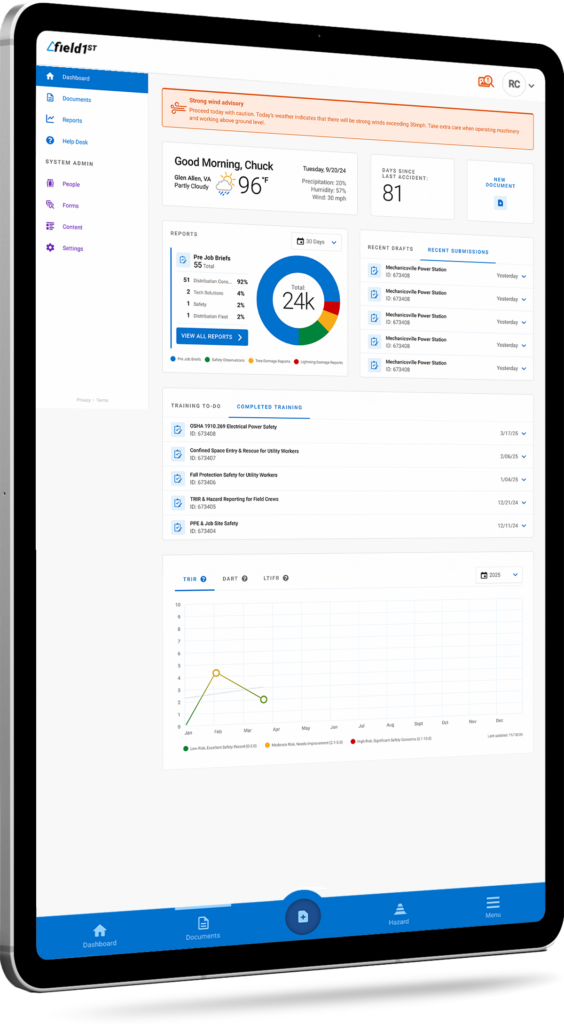
With Field1st, reports are auto-tagged by location, task type, crew, and timestamp. You just check your dashboard and act.
Step 6: Share Learnings and Close the Loop
Want to know the fastest way to kill a safety program? Keep your fixes a secret. When workers report a near miss and never hear back, they stop reporting. They stop caring. But when they see change—when you show them the impact—they lean in.
Close the loop by communicating:
- What happened after the report
- What was fixed or changed
- Why their input mattered
Highlight it in toolbox talks. Pin it to the breakroom wall. Mention names (with permission). Show “before and after” improvements. Make heroes out of those who spoke up. Build a culture where reporting is rewarded, not forgotten.
Related Read: Best Near Miss Reporting Software
Common Challenges in Near Miss Reporting
Even with the best intentions, near miss programs often fall apart because of friction, fear, or flat-out confusion. Here’s where most systems break down—and how to fix it.
Reporting Is Too Time-Consuming in the Field
If logging a near miss takes more than a couple of minutes, forget it. Crews are busy. They’re moving fast. They don’t have time to hunt down paper forms, find a supervisor, or type long entries on clunky systems. If the process isn’t fast and mobile, it won’t happen.
Field Reality: Your reporting system needs to fit the rhythm of the field, not slow it down.
Reports Go Unnoticed or Unfollowed
Nothing kills participation faster than silence. If a worker logs a report and never hears back, they assume it didn’t matter. And if reports pile up with no review, no investigation, and no visible changes, reporting dries up.
Result: You don’t just lose data—you lose trust.
Workers Fear Blame or Retaliation
Near misses often highlight unsafe behavior, missed steps, or violations. If workers think they’ll get in trouble—or worse, lose their job—they won’t say a word. Fear shuts down communication.
Fix: Safety leadership must send a loud and clear message: reporting near misses protects everyone. It’s never about punishment.
Field Teams Don’t Know What to Report
Sometimes workers don’t report because they don’t recognize a near miss when they see one. They think, “No one got hurt, so it doesn’t count.” Without clear examples and definitions, most near misses go unspoken.
Solution: Train your crew with real examples. Point to moments on-site. Reinforce it in safety meetings.
Safety Data Gets Lost in Spreadsheets
Tracking near misses in Excel might work on a 5-person crew. But when you’re running multiple sites with dozens of reports per week, spreadsheets fall apart. They’re not searchable, not alert-driven, and definitely not audit-ready.
Modern Safety Requires Modern Systems.
Field1st Fixes It:
- Fast, mobile-first near miss reporting right from the field
- Automated alerts for follow-up so nothing slips through the cracks
- Configurable workflows and checklists built around your process
- Searchable, exportable logs for full compliance and audit readiness
- Anonymous reporting options to eliminate fear and increase honesty
With Field1st, near miss reporting becomes second nature. Crews speak up. Leaders respond. And the whole system gets smarter every day.
Best Practices to Build a Strong Near Miss Reporting Culture
Getting people to report near misses isn’t about policy—it’s about behavior. It’s about trust. Here’s how to build a culture where reporting is the norm, not the exception:
Lead by Example — Safety Starts with Leadership
If supervisors never report near misses, neither will the crew. Period. Leaders need to model the behavior they expect to see. When a site manager logs a near miss in the open, it shows the team that safety is active, not reactive.
Key Move: Have your leads share real examples during meetings—what they saw, how they reported it, and what action was taken.
Make Reporting Simple and Accessible
No one’s pulling out a clipboard mid-shift. If reporting takes too long, it won’t happen. The process must be mobile, intuitive, and available wherever the work is.
Ideal Workflow: One tap. One photo. One short description. Done.
Keep It Blame-Free and Confidential
Create an environment where the first reaction to a report isn’t, “Who messed up?” It’s, “What can we learn?” Fear of blame kills transparency. Your team should know that reporting a near miss won’t get them punished—it’ll get them protected.
Allow anonymous reports. Celebrate transparency. Lead with questions, not consequences.
Follow Up and Close the Loop
You asked for reports. Someone submitted one. Now what?
If the answer is nothing, that’s a massive miss. Every report deserves:
- A review
- A response
- A resolution
Loop back and show what was learned or fixed. That’s how you build confidence in the system.
Recognize and Reward Reporting Behavior
Reinforce what you want repeated. When someone reports a near miss that prevents a future incident, spotlight it. Recognition doesn’t have to be expensive—a shoutout, a thank-you note, a small reward goes a long way.
Momentum builds when your team sees that speaking up actually leads to change.
Field1st Makes It Easy
With Field1st, you can:
- Assign and track follow-up tasks
- Send acknowledgments right inside the app
- Review trends across crews and projects
Safety culture doesn’t build itself—but with the right tools and consistent action, it becomes a reflex.
Stay Safer, Stay Compliant with Field1st
The best time to report a near miss? Right when it happens.
But for that to work, reporting has to be easy, fast, and frictionless.
With Field1st, your crew gets a reporting system they’ll actually use:
- Mobile-first near miss reporting tools
- Structured forms and smart checklists
- Photo and voice-note uploads
- Dashboard tracking and compliance visibility
- Anonymous submissions for psychological safety
Don’t wait for an injury to prove the system is broken. Get ahead of risk.
Book your Field1st demo now — and build a culture that sees danger before it strikes.