What is a job safety analysis (JSA)?
A job safety analysis is a structured way to look at a specific job before it starts, break it into a sequence of steps, identify the hazard in each step, and decide how to control that hazard.
The goal is simple: build safety into the task itself, so it is part of the work rather than a form stapled on top of it. You will hear it called a job hazard analysis (JHA) or a task hazard analysis. These are the same practice under different names. OSHA uses “job hazard analysis” in its guidance. Your company may call it a JSA, a JHA, a pre-task plan, or a tailboard.
A JSA focuses on the relationship between four things: the worker, the task, the tools, and the environment. The same worker doing the same task becomes higher risk when the tools change, the weather turns, or the crew next to them starts moving steel. That is why a JSA is a look at one job, on one day, under the conditions actually present, not a generic description of a job type.
Does OSHA require a job safety analysis?
This is the question that trips up most safety leaders, so here is the direct answer. OSHA does not require a document titled “Job Safety Analysis” in every standard. But the activities that make up a JSA, assessing hazards and documenting the assessment, are required by law. The label is optional. The work is not.
| Standard or guidance | What it requires | What you must be able to show |
|---|---|---|
| 29 CFR 1910.132(d)(1) | Assess the workplace for hazards and select PPE based on that assessment. | A task-level hazard assessment tied to the specific PPE chosen for the specific hazard. |
| 29 CFR 1910.132(d)(2) | Verify the hazard assessment through a written certification. | A certification with the workplace, the certifier, the date, and a document identifier. |
| 29 CFR 1926.21(b)(2) | Instruct each employee in recognizing and avoiding unsafe conditions. | Training logs, documented pre-task briefings, proof of instruction by role and task. |
| OSHA Publication 3071 | The foundational how-to for a job hazard analysis: involve employees, review incident history, break the job into steps. | Analyses that prioritize the highest-risk jobs and get updated after incidents and changes. |
The practical takeaway: OSHA cites organizations for weak execution, not for word choice. Vague hazard descriptions, missing control documentation, and templates that were signed but never worked are what draw citations. A rigorous JSA is a shield against liability, not just a best practice.
What should a job safety analysis template include?
A JSA template earns its keep only if it forces the right level of detail. A generic form with three columns and a signature line does not. Here is the anatomy of a template that holds up in the field and in an audit.
| Section | What it captures | Why it matters |
|---|---|---|
| 1. Header and job info | Exact task name, location, department, date, supervisor, crew. Not “HVAC work,” but “Install rooftop unit on Building C.” | Sets the operational baseline, ties the analysis to accountable people, and makes the record findable later. |
| 2. Sequence of job steps | The task broken into six to ten steps, each starting with an action verb: “Set up ladder,” “Isolate energy source.” | Micro-hazards hide inside big steps. Breaking the job down is what surfaces them. |
| 3. Hazards per step | The specific physical, chemical, biological, or ergonomic hazard in each step, including struck-by, inhalation, and line-of-fire risks. | This is the hazard assessment OSHA requires, done where the risk actually lives. |
| 4. Controls per hazard | A specific control matched to each hazard, chosen from the hierarchy of controls, not “use caution.” | Turns the analysis into action. Vague warnings are operationally and legally useless. |
| 5. Owner and stop-work triggers | A named person accountable for each control, plus the conditions that require stopping work. | Makes controls verifiable in the field and prevents the quiet assumption that safety is handled. |
| 6. Briefing and sign-off | Crew acknowledgment signatures after a pre-task briefing on the hazards and controls. | Meets the instruction-evidence requirement and confirms the crew understood the plan. |
Two of these are where most templates fall short. Section 5, the named owner, is what separates a control that gets done from a control everyone assumed someone else did. And section 3 is where “be careful” quietly replaces real hazard analysis. If your template lets a crew write “be careful,” your template is the problem.
The hierarchy of controls: the engine of the JSA
Every control in section 4 should come from the hierarchy of controls, the ranking of hazard controls from most to least effective endorsed by NIOSH and OSHA. The single most common failure in a weak JSA is reaching straight for PPE. PPE is the last line of defense, not the first. Work down this list in order, and only move to the next tier when the ones above cannot fully control the hazard.
| Tier | Strategy | Field example |
|---|---|---|
| 1. Elimination | Physically remove the hazard. | Install a permanent stair instead of a portable ladder to the mezzanine. |
| 2. Substitution | Replace the hazard with something safer. | Swap a toxic solvent for a water-based, non-toxic cleaner. |
| 3. Engineering controls | Isolate people from the hazard. | Machine guards, local exhaust ventilation, physical barriers around the work. |
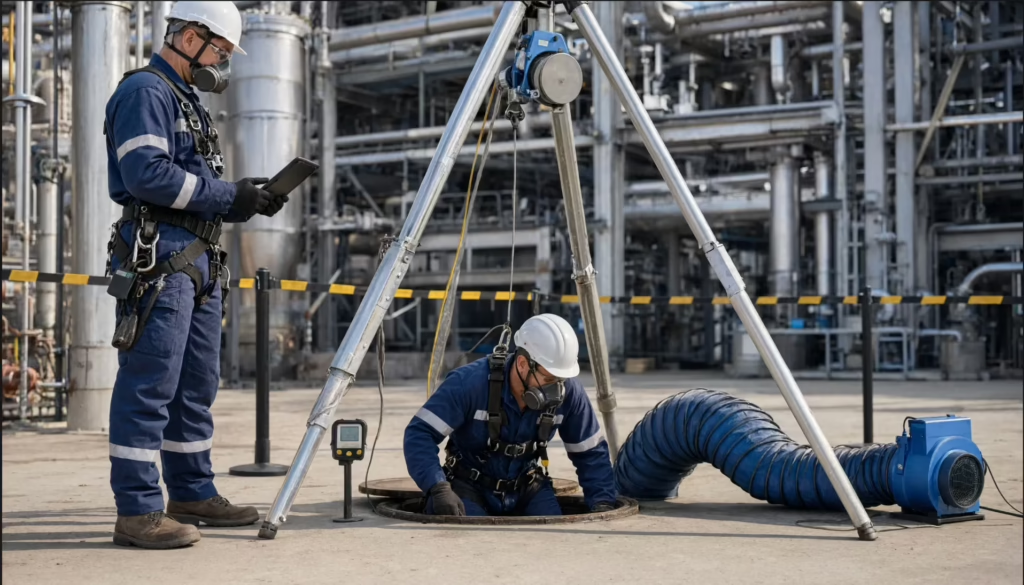
| 4. Administrative controls | Change how people work. | Lockout/tagout, a two-person confined-space rule, dedicated equipment spotters. |
| 5. PPE | Put a barrier on the worker, as a last resort. | Fall-protection harness, respirator, hi-vis, impact goggles. |
A JSA that lists “wear PPE” for a hazard that could have been engineered out is not just weak, it is evidence that the analysis skipped the most effective options. A strong template asks, for every hazard, whether it can be eliminated or engineered away before anyone reaches for a harness.
How do you conduct a job safety analysis?
The template is the easy part. The safety comes from how you run the analysis. Here is the six-step method, drawn from OSHA and NIOSH best practice.
- 1. Pick the right job. Prioritize jobs with a history of injuries, high-energy tasks like confined-space entry or lockout/tagout, newly changed procedures, and non-routine work. Start where the consequences are worst.
- 2. Break the job into steps. Watch a qualified worker do the task under normal conditions. Keep it under ten steps. The flat-tire test works: “Park the vehicle,” “Remove the spare,” “Loosen the lug nuts.” That is the right grain.
- 3. Identify the hazard in each step. For every step, ask “what could go wrong, and how?” Look past the obvious to struck-by, inhalation, ergonomic strain, and environmental factors like traffic and weather.
- 4. Choose controls from the hierarchy. Do not jump to PPE. Try to design or engineer the hazard out first, then use procedure, then equip the worker. Assign a named owner to every control.
- 5. Write it so a crew can act on it. Replace “be careful” with the specific engineering control, the exact procedure, and the specific PPE. If a control is not specific enough to verify, it is not a control.
- 6. Validate, then keep it alive. Walk it through with the people doing the work. Then treat the JSA as living. If the scope shifts, the weather turns, or a new contractor enters the zone, the crew pauses, rehuddles, and revises.
That last step is where paper and reality part ways.
Why paper JSA templates fail in the field
A downloadable PDF template is a fine place to start and a dangerous place to stop. Here is what happens to a static template on a real job.
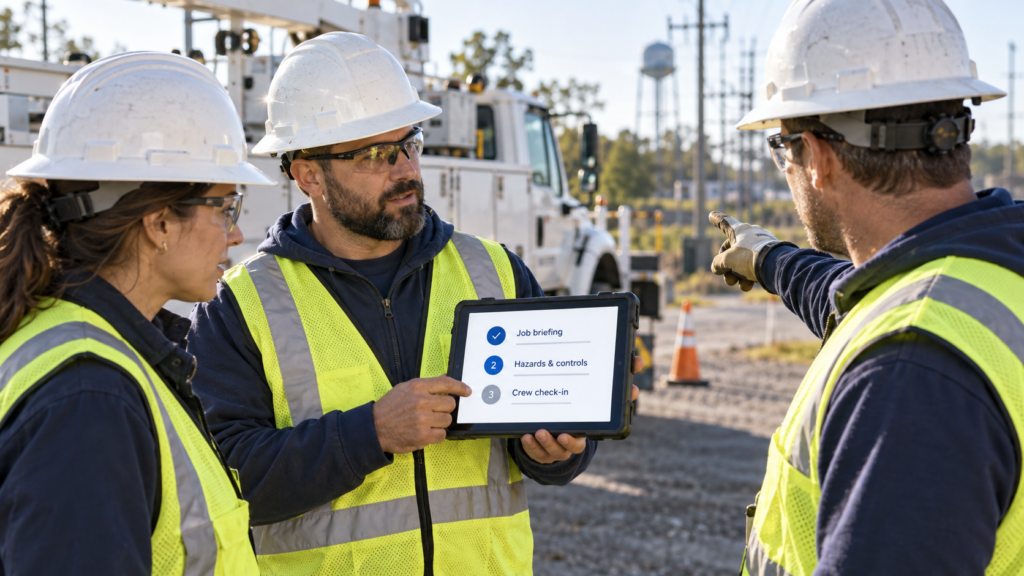
The crew arrives at dawn. The supervisor pulls out a generic JSA, checks the boxes, signs it, and files it to satisfy compliance. Ten minutes later a subcontractor moves an excavator into the active zone, the wind picks up, and the signed JSA is already describing a job that no longer exists. The document is complete. The analysis is obsolete.
Then there is the friction. A worker in heavy gloves, in the cold, does not have the time or dexterity to write detailed hazard descriptions on a clipboard. So the form gets pencil-whipped, rushed through or back-filled at the end of the shift, and the data that reaches leadership is thin and late. A pencil-whipped JSA is worse than none, because it looks like control.
Paper also has no context and no visibility. A sheet of paper cannot tell a crew the minimum approach distance for the energized line they are working near, based on where they are actually standing. And leadership finds out a critical control was missing during the incident investigation, not before the work. That is the reactive trap: managing safety by looking at lagging indicators, one autopsy at a time.
The fix is not a better PDF. It is capturing the analysis where the work happens, in a way crews will actually use, and keeping it live as conditions change.
How Field1st turns the JSA template into a field workflow
Field1st is an AI-native safety platform built for the field, not the back office. It takes the template structure above and makes it something a gloved crew in a dead zone will actually complete, and keep current.
- Voice1st capture. Crews speak through the pre-task plan instead of typing. AI maps their words into the right fields, hands-free, in under two minutes.
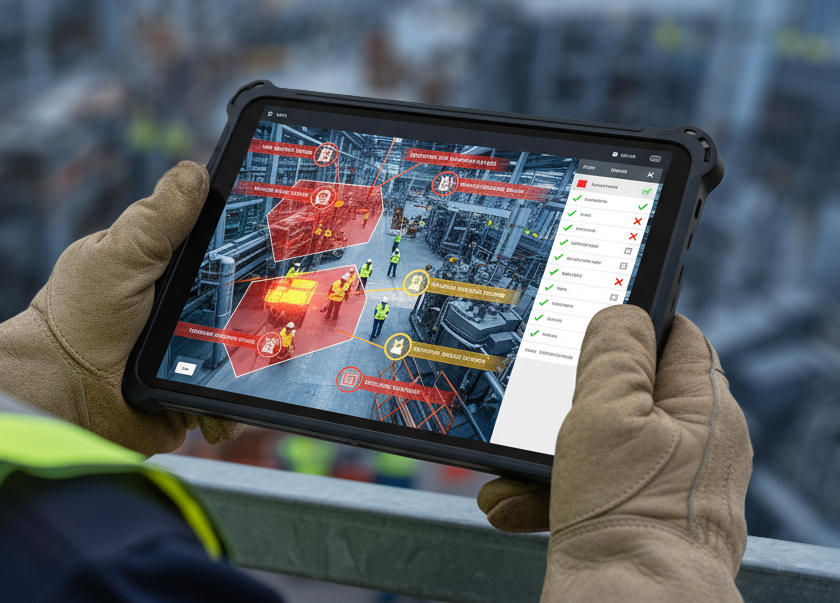
- HazardID from a photo. Point the camera at the job. Vision AI flags likely hazards, checks them against OSHA and company policy, and suggests controls before work starts.
- A pre-submit check. Before the JSA is finalized, the safety agent asks what obvious hazards or controls are missing, catching gaps at the tailgate instead of the investigation.
- Guest access for subs. Transient subcontractors join by QR code with no per-seat license, so multi-employer crews are inside the same JSA process as your own people.
- Offline-first. In remote sites and dead zones the analysis continues and syncs the moment a signal returns.
See it on one of your own forms
Stop duct-taping safety together with paper and basic apps. Bring one JSA your crews use today and watch it come alive in 20 minutes with Voice1st and HazardID. No slides, no prep, no pressure.
Book my walkthroughFrequently asked questions
What is the difference between a JSA and a JHA?
None in practice. Job safety analysis and job hazard analysis describe the same step-by-step hazard analysis. OSHA uses “job hazard analysis” in its guidance; many companies say “JSA.” Task hazard analysis is another name for it.
Does OSHA require a job safety analysis?
OSHA does not require the specific title, but it requires the underlying hazard assessment and its documentation under 29 CFR 1910.132(d) and instruction under 1926.21(b)(2). Publication 3071 is OSHA’s how-to guidance. Citations come from weak execution, not word choice.
How many steps should a JSA have?
Usually six to ten. Fewer and you hide micro-hazards inside broad steps; more and the analysis gets unwieldy. Each step should start with an action verb.
What is the most important part of a JSA template?
Two parts do the heavy lifting: a specific control matched to each hazard from the hierarchy of controls, and a named owner accountable for each control. Without those, the template is a checklist, not an analysis.
How often should a JSA be updated?
Whenever the work does. A JSA is a living document. Update it when the scope changes, the weather turns, a new contractor enters the zone, or after any incident or near-miss.
Related reads: Best JHA & JSA Software · Field1st vs SafetyCulture