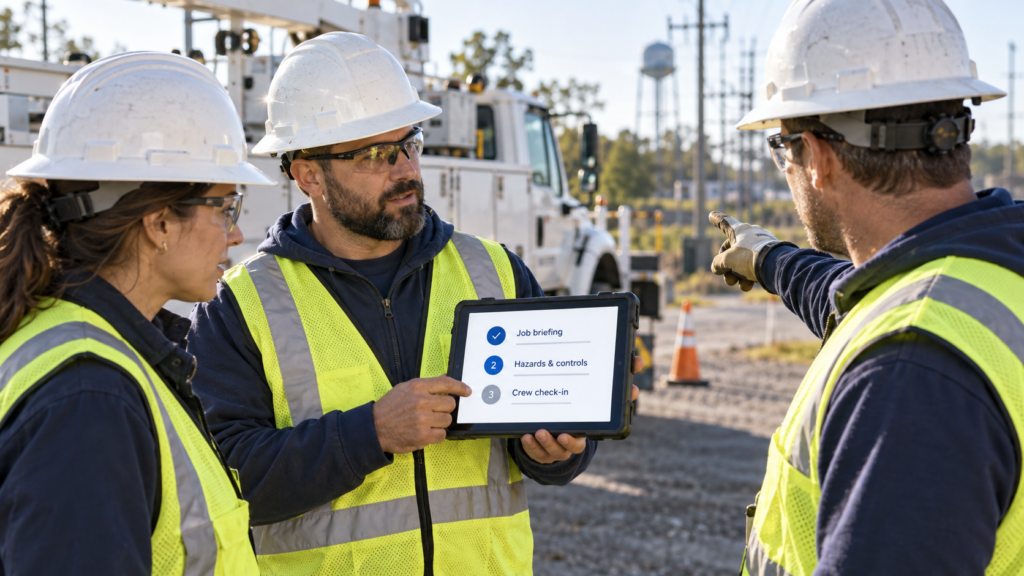
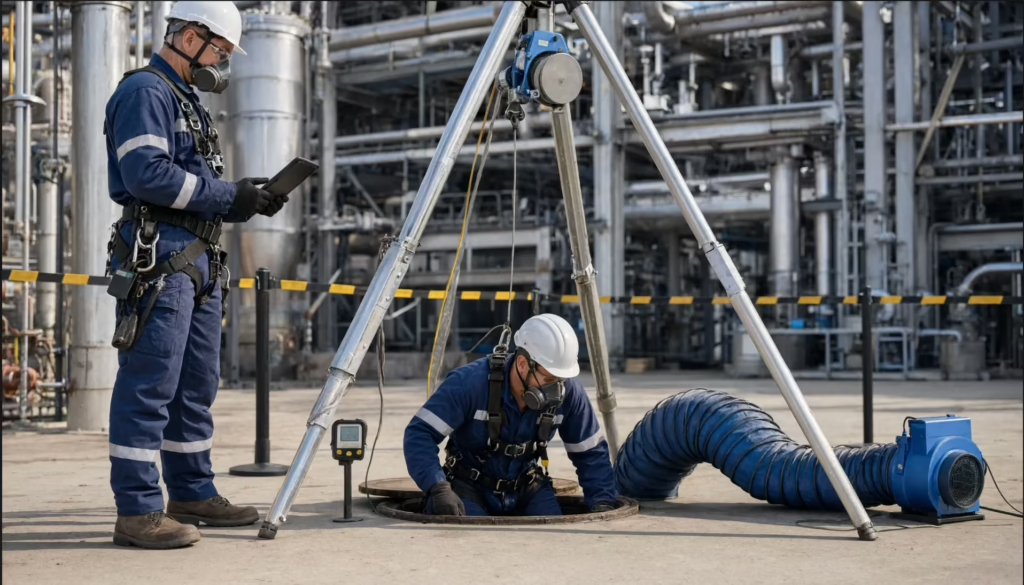
Oil and gas inspection safety depends on verifying field conditions—not just completing inspection checklists. Weak documentation and missed follow-up are common causes of safety gaps.
The most frequent inspection failures include incomplete documentation, gas detector issues, confined space hazards, hot work risks, energy isolation failures, and unresolved corrective actions.
Effective inspections should verify controls, capture photo evidence, assign ownership, and confirm corrective action closeout to reduce repeat incidents.
OSHA recommends documenting hazards, tracking corrective actions, reviewing inspection trends, and using leading indicators to strengthen safety program performance.
Digital inspection tools improve consistency by connecting inspections, JHAs, corrective actions, and audit trails, giving supervisors real-time visibility across crews, contractors, and job sites.
The best oil and gas inspection safety platforms help teams capture accurate field data, identify recurring risks earlier, and improve compliance through standardized mobile workflows.
Oil and gas inspection safety depends on what crews verify in the field, not what gets rushed onto a form. Safety managers, operations leaders, and field supervisors need inspection processes that verify controls, document field conditions, assign follow-up, and show recurring issues before they turn into incidents, delays, or compliance problems.
The most common failures usually come from weak verification. A form may show that gas monitoring, hot work controls, isolation, access, or corrective actions were addressed, but the field condition may tell a different story.
This article breaks down 10 common oil and gas inspection failures, why they create exposure, and how teams can prevent them across crews, contractors, sites, and shifts.
What are the most common oil and gas inspection safety failures?
The most common oil and gas inspection safety failures usually happen in the space between the form and the field. The inspection may be completed, but the record doesn’t always prove that the right control was verified, the hazard was assigned, or the fix was confirmed.
The failures below focus on that gap. Some involve high-risk work, like gas detection, confined space entry, hot work, and energy isolation. Others involve the follow-through that makes inspections useful, including documentation, corrective actions, shift handoff, and repeat findings.
1. Incomplete inspection documentation
Incomplete documentation makes it hard to prove what was checked, what was found, and what happened next. Vague notes like “fixed,” “reviewed,” or “monitor” don’t give supervisors enough detail to act.
Prevention starts with specific fields for location, condition, risk level, photo evidence, assigned owner, due date, and closeout method. For higher-risk findings, text notes alone usually aren’t enough.
2. Gas detectors not calibrated, bump tested, or documented
A gas monitor listed on an inspection form doesn’t prove the instrument was ready to use. Crews also need to confirm bump test status, calibration status, readings, location, and timing.
NIOSH has warned that hydrocarbon gases and vapors can create serious hazards near tanks and process-fluid work. BSEE has also reported inspection issues in the past involving non-operable gas detectors, missing calibration processes, failed bump tests, and missing documentation.
3. Confined space entry hazards missed or poorly controlled
Tanks, pits, vessels, and similar spaces can change quickly. A reading taken before entry may not reflect conditions after work starts, especially when fluids, vapors, ventilation, or nearby tasks change.
OSHA’s permit-required confined space standard requires atmospheric testing for oxygen, flammable gases and vapors, and toxic air contaminants before entry when the standard applies. Teams should also define when continuous monitoring, ventilation checks, rescue planning, and entry reassessment are required.
4. Hot work controls not verified near hydrocarbons
Hot work failures often start with assumptions. Equipment is believed to be empty. Vapors are assumed to be gone. Isolation is treated as complete because the permit was signed.
OSHA’s oil and gas eTool warns against assuming that flammable vapors or gases are absent in empty equipment. It then points to controls such as testing, monitoring, isolation, and lockout/tagout for hot work and welding around oilfield equipment. Crews should verify the atmosphere, nearby vapor sources, isolation status, fire watch coverage, and changing work conditions before hot work begins.
5. Energy isolation or stored energy not verified
A lock on a device doesn’t always prove the energy source was correctly isolated. Stored pressure, hydraulic energy, electrical energy, and mechanical movement can still create exposure if the isolation plan is incomplete.
API shares expectations for documented energy isolation practices, personnel training, and verification that isolation and stored energy release have been completed in oil and gas drilling and servicing operations. Before work starts, inspections should confirm isolation points, zero-energy verification, stored energy release, and handoff between crews.
6. Walking-working surface, housekeeping, and egress hazards left open
Leaks, loose material, blocked access, corrosion, missing grating, and poor housekeeping often get normalized because crews work around them every day.
OSHA requires walking-working surfaces to be kept clean, orderly, sanitary, and dry where feasible, and also requires employers to inspect them regularly and correct or guard hazardous conditions under 29 CFR 1910.22. Inspection forms should make it easy to flag access and egress problems, then route them to someone who can correct the condition.
7. Mechanical integrity inspections not documented properly
Mechanical integrity failures become harder to defend when records don’t show what was inspected, who inspected it, what method was used, and what the result was.
For covered processes, OSHA’s PSM standard requires inspections and tests on covered equipment to follow recognized and generally accepted good engineering practices. That means documentation that includes the date, inspector, equipment identifier, inspection description, and results under 29 CFR 1910.119.
8. Bypassed safety devices not tracked or restored
A safety device may be bypassed for maintenance or troubleshooting, but the risk can continue on. The bypass carries into another shift, the restoration step gets missed, or the record doesn’t show why the device was bypassed.
BSEE identified bypassed safety device documentation and tracking issues in Safety Alert No. 501. The alert is offshore guidance, but the lesson applies more broadly: bypasses need clear tagging, documentation, ownership, handoff, and restoration verification.
9. Excavation or line strike controls not coordinated
Excavation near oil and gas infrastructure can fail when locating, markings, handoff, and contractor coordination are treated as admin steps instead of field controls.
PHMSA’s 2026 advisory on excavation damage prevention around pipelines emphasizes accurate, timely locating and proactive coordination with excavators. This is important when pipeline, gathering, or facility-interface work is part of the operation.
10. Corrective actions closed without field verification
A corrective action closed from a desk can create false confidence. A work order, email, or note may show movement, but the hazard may still exist at the tank battery, rig floor, access platform, or work area.
Closeout should match the risk. Some actions need a photo. Others need retesting, supervisor sign-off, maintenance verification, or a field walkdown before the item is truly complete.
How can oil and gas teams prevent repeat inspection failures?
Repeat failures decrease when inspections produce usable evidence and clear action. Crews need a process that helps them verify controls, not just submit a form before the job starts.
A practical prevention workflow looks like this:
Step
What to Check
Why It Helps
Define the trigger
Task, location, equipment, permit, or condition that requires inspection
Reduces missed inspections during non-routine work
Verify the control
Gas test, isolation, access, fire watch, ventilation, or guarding
Confirms the control works under current conditions
Capture evidence
Photos, readings, notes, time stamps, and location details
Gives supervisors enough context to act
Assign ownership
Named owner, due date, and risk level
Prevents findings from sitting unresolved
Confirm closeout
Field check, retest, photo, or supervisor approval
Reduces paper-only corrective action closure
Review patterns
Repeat findings by crew, asset, contractor, or site
Shows where the same problem keeps returning
Standardized digital safety inspection workflows can support this process by making forms more consistent and helping teams capture the right details in the field. For high-risk tasks, inspections should also connect to the job hazard analysis before high-risk work so crews can reassess when the task, conditions, or controls change.
How Field1st supports oil and gas inspection workflows
Field1st is built as a field-first safety operations platform for high-risk work. It helps crews capture safety information through voice, photos, mobile inputs, and guided workflows, then turns that information into safety visibility for supervisors, safety teams, and operations leaders.
Field1st helps teams connect field conditions to follow-up:
For crews documenting hazards during active work, voice, photo, and mobile inputs give teams a faster way to capture inspection details while the condition is still visible.
For supervisors reviewing vague inspection notes, guided workflows help standardize the information needed for follow-up.
For safety teams managing open actions, corrective action routing helps connect inspection findings to ownership and closeout.
For leaders seeing the same findings across sites, analytics help identify repeated inspection issues by crew, contractor, asset, or location.
For teams trying to standardize inspection forms, field-ready safety templates give crews a structured starting point for common safety workflows.
Field1st doesn’t replace qualified inspections, regulatory judgment, or supervisor responsibility. It gives teams a practical way to capture inspection findings, route corrective actions, and turn safety data into clearer operational visibility.
See how Field1st helps field teams capture inspection findings, route corrective actions, and turn safety data into clearer operational visibility.
FAQ
What records should oil and gas inspection teams keep?
Oil and gas inspection records should show what was inspected, who inspected it, when it was inspected, what condition was found, what evidence was captured, who owns the corrective action, and how closeout was verified. For high-risk work, teams may also need gas test results, calibration checks, photos, permits, JSA details, and supervisor approvals.
How often should oil and gas inspections be performed?
Inspection frequency depends on the work type, equipment, hazard level, company policy, and applicable regulation. A daily site inspection may not be enough for changing tasks such as hot work, confined space entry, excavation, or maintenance involving stored energy. Crews should reinspect when conditions change, not only when the schedule says an inspection is due.
What is the difference between a JSA and a safety inspection?
A JSA identifies job steps, hazards, and controls before work begins. A safety inspection checks actual field conditions, equipment, access, controls, and follow-up needs. The two should connect. If an inspection finds a new hazard, the JSA may need to be updated before work continues.
What should supervisors do when conditions change after an inspection?
Supervisors should stop and reassess the work when conditions change. Examples include weather shifts, SIMOPS, contractor overlap, equipment movement, new ignition sources, or abnormal readings. The crew should verify whether the original controls still apply, update the documentation, and assign any new corrective actions before continuing.
Do OSHA oil and gas inspection requirements apply the same way to every site?
No. OSHA, BSEE, PHMSA, API, and company requirements can apply differently depending on the operation, location, equipment, and hazard. OSHA’s oil and gas well drilling and servicing eTool focuses on land-based drilling and servicing hazards, while BSEE and PHMSA sources apply to different operating contexts.