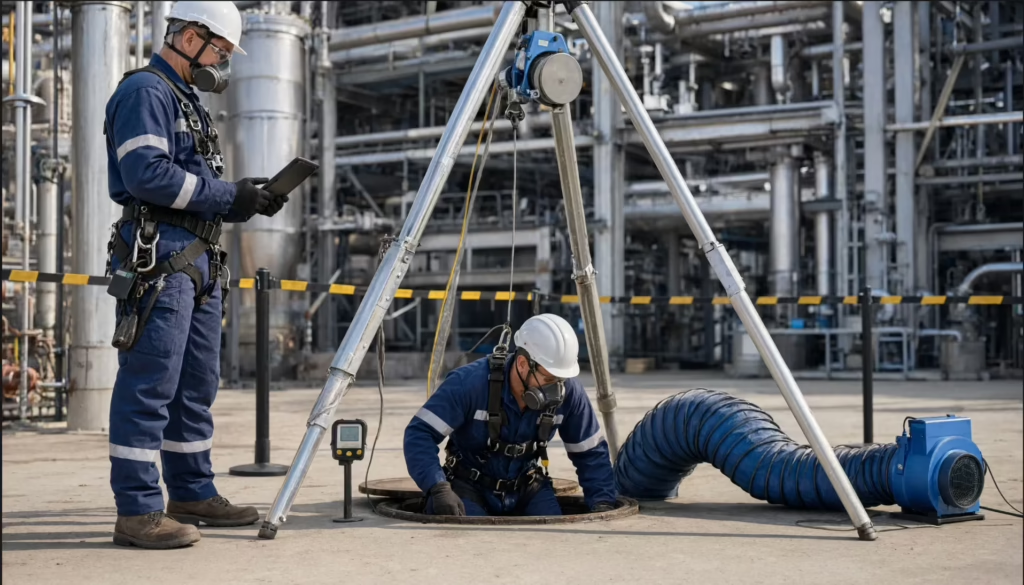
Industrial contractor safety software is built for crews working inside somebody else’s operating facility: offline capture in plants and vessels, documentation that covers subcontractors without charging per seat, and a safety record you can hand to the owner who hired you. That is a different product from the jobsite platforms sold to commercial general contractors, and buying the wrong class is the expensive mistake in this category. This guide compares 10 platforms on the three things that actually decide it, with every competitor claim traced to the vendor’s own documentation.
Field1st publishes this guide and appears in it. We say where we win and where we don’t, and we cite the source for every claim about somebody else’s product.
Running commercial work with subs coming to you instead? Read the companion guide: Best Construction Health and Safety Management Software. Different buyer, different shortlist.
What Is the Best Industrial Contractor Safety Software?
It depends on the work. Commercial general contractors are well served by HammerTech and Procore. Industrial and specialty trade contractors, the crews doing plant maintenance, turnarounds and energized work, need offline capture, a subcontractor model that is not per seat, and safety records they can hand to the owner who hired them. Only one vendor in this guide has productized that last one.
The Short Version
- Most tools in this category were built for the commercial general contractor running a jobsite, not for the specialty or industrial contractor working inside somebody else’s operating plant. Those are different problems with different buyers.
- For an industrial contractor, a safety record is not paperwork. It is contract currency. ISNetworld alone reports 900 hiring clients and 90,000 contractors, and owners configure their own grade thresholds for site access and awards.
- The thinnest capability in the whole market: almost nobody lets you hand a defensible safety record to the plant owner who hired you. We found exactly one vendor that has productized it.
- The completely unclaimed position: turnaround and shutdown work. We checked every vendor in this guide. Not one markets surge onboarding of large temporary crews. The only vendors addressing turnarounds at all do it with wearables and location hardware, not safety records.
- Offline is where the marketing and the documentation diverge most. Read that section before you sign anything.
Why Industrial and Specialty Contractors Are Not Buying the Same Product
A commercial general contractor controls the site. They set the rules, run the orientations, and the subs come to them. Software built for that world assumes the buyer is the hiring entity at the top of the pyramid.
An industrial or specialty contractor is in the opposite position. You are a guest in an operating facility. The refinery, the utility, the mill, the chemical plant sets the rules. You arrive with a crew, work inside somebody else’s permit system and hazard environment, and leave. Then you do it again next month at a different plant with different requirements, and every one of those clients wants evidence you worked safely.
Three consequences follow, and they are the buying criteria.
1. Your safety record decides whether you get the work
US industrial owners largely do not evaluate contractor safety themselves. They outsource it to prequalification networks.
ISNetworld reports 900 hiring clients and 90,000 active contractors and suppliers across 85 or more countries, with named industries that read like a target list for this audience: pipeline, offshore, refining, biopharmaceutical, manufacturing, mining, rail, energy and utilities. On July 23, 2026, ISN announced it had passed 175 utility, power generation, renewable energy and data center clients, covering more than 2,400 sites and a network of more than 38,500 contractors in that segment alone. Contractor documents are reviewed by its Review and Verification Services team against both regulatory and hiring-client requirements, and client requirements can be configured by location, level of risk, or specific designations and best practices.
Avetta reports more than 360,000 businesses in over 120 countries, collecting and monitoring safety performance, audits, certifications and documents so clients can select contractors. Veriforce states directly that “hiring clients and insurers still rely heavily on Experience Modification Rate (EMR) and TRIR,” noting that “a score below 1.0 suggests better-than-average performance.” To its credit, Veriforce also argues against using those numbers as standalone gates.
Here is the part to be precise about, because most content overstates it: none of these networks publishes a universal TRIR or EMR cutoff. Each owner-client sets its own requirements and thresholds. What is consistent is the input. Your profile is built from OSHA logs, injury and illness rates including TRIR, DART and EMR, written safety programs, training records, insurance certificates and regulatory documentation. In practice, standing in these networks is a precondition for being awarded or keeping contracts with many operators.
All of that traces back to daily field execution. If your crews are pencil whipping pre-task plans, the damage does not show up in a safety meeting. It shows up in a prequalification score, and then in a bid you did not win.
2. Multi-employer doctrine means the paperwork is not only about your own people
OSHA’s multi-employer citation policy, CPL 02-00-124, defines four roles, and a single employer can occupy more than one on the same day:
- Creating employer: caused the hazardous condition. Citable even if the only workers exposed belong to another employer.
- Exposing employer: its own employees are exposed. If it cannot correct the hazard, it must ask whoever can, inform its employees, and take feasible alternative protective measures.
- Correcting employer: responsible for correcting a hazard on a shared site. Must exercise reasonable care in preventing and discovering violations.
- Controlling employer: has general supervisory authority, including power to require others to correct. Must exercise reasonable care to prevent and detect violations.
For a specialty contractor with subs of your own, that means documenting hazards you did not create and work you did not perform. Software that charges per seat makes this structurally expensive, and the cheapest path becomes paper, which is the same as no record when you need one.
3. Federal recordkeeping applies to you differently than you think
Two facts worth knowing before a vendor tells you their compliance module is urgent.
Electronic submission of Forms 300 and 301 under 29 CFR 1904.41 applies to establishments with 100 or more employees in industries listed in Appendix B. In the construction range, Appendix B contains exactly one entry: 2381, foundation, structure and building exterior contractors.
It does not include 237 heavy and civil engineering construction, 2371 utility system construction, or 2382, 2383 and 2389, the mechanical, finishing and other specialty trades. Those file the 300A only. One thing to check if you do water or sewer work: Appendix B does list 2213, water, sewage and other systems, so some utility contractors are captured through that code rather than a construction one. Recordkeeping, retention for five years, February 1 through April 30 posting, and the 8-hour and 24-hour reporting rules under 1904.39 still apply in full.
And OSHA is now enforcing the filing itself. A March 23, 2026 memo created a Non-Responder Enforcement Program targeting employers who never submitted their calendar year 2025 Form 300A data. OSHA collects Forms 300 and 301 through the same system but said it would not build a non-responder list for those. It had until September 2, 2026, six months after the March 2 submission deadline, to issue citations, and that window has now closed.
Separately, OSHA reissued the Heat National Emphasis Program as CPL 03-00-024 on April 10, 2026, for up to five more years. It triggers at a heat index of 80°F, directs programmed inspections on days the National Weather Service posts a local heat warning or advisory, and specifically names NAICS 2371 utility system construction and 2373 highway, street and bridge construction. There is still no federal heat standard, so citations run through the General Duty Clause.
Start Where It Hurts Most
The private construction industry recorded 1,034 fatal work injuries in 2024, against a total recordable case rate of 2.2 per 100 full-time workers, the sort of number that looks acceptable on a dashboard and does not describe the risk at all. Specialty trade contractors came in at 2.3, heavy and civil engineering at 1.8.
The daily reality behind those figures is familiar. The pre-task plan takes 45 minutes to do properly, so it takes four, with last week’s hazards copied forward. The crew rotates between plant units and the tool loses the thread. Half the workforce on a turnaround has been on your payroll for nine days. Your subs are on paper because nobody was going to buy 80 more licenses for six weeks of work. Then the client asks for evidence of safe delivery and somebody spends two days assembling a binder from photographs and memory.
None of that is a discipline problem. It is what happens when the tool costs more time than the job allows, and when the record was never designed to leave the building.
Bring one form your crews use today. Watch it come alive in 20 minutes. No slides, no prep, no pressure.
The Platforms, and Who They Are Actually For
Facts below were verified against vendor documentation on August 25, 2026. Where a vendor claims a capability in marketing but its own help documentation limits it, both are noted, because that gap is where implementations fail.
HammerTech
Melbourne, with a US$70 million growth investment led by Riverwood Capital announced in July 2024. The strongest multi-employer site orchestration product here: worker inductions and orientations, subcontractor compliance, permits, pre-task plans and inspections, with more than 3.6 million workers inducted as of that 2024 release.
It is the only vendor in this guide with a purpose-built industrial page, naming refineries, chemical plants and mining, with digitized hot work, confined space, excavation and LOTO permits, offline workflows across large sites, and audit-ready reports for regulators or owners. EPC contractors are the stated buyer. Its subcontractor answer is also the clearest published one in the category: pricing is based on annual construction volume and the number of active job sites rather than seats, the pricing page says plainly that HammerTech does not use per-user pricing, and subcontractors do not need to purchase a license.
Two caveats. That free access is provided by the general contractor managing the project, so a specialty contractor running its own program is a paying customer, and its records live spread across each client’s separate tenancy. And the industrial page is framed around capital project delivery. It does not mention turnarounds, shutdowns or maintenance work anywhere.
Best for: general contractors and EPC firms who control the site and need to manage many subs.
SALUS
Founded in Vancouver, now listing offices in Vancouver and Seattle. It closed an $8 million Series A in December 2023, alongside more than C$2.6 million from the Government of Canada through PacifiCan the month before. This is the most trade-native product in the guide, with pages written in the correct hazard vocabulary for electrical work, energized work, LOTO and arc flash, mechanical hot work, confined space and rigging permits, heavy civil and structural steel.
It is also the only vendor we found that has productized handing your record to whoever hired you. The Trust Portal is a shareable live link exposing training records, certifications, licenses, insurance documents, equipment readiness, form completion and corrective action evidence, and owners, GCs, auditors, insurers and clients can open it in a browser with no SALUS account. It is honest about its boundary too, stating that if a client contractually requires ISNetworld, Avetta or another network, you still maintain that requirement.
Its offline claims are the boldest here, covering forms, inspections, incidents, SDS sheets, certificates, equipment profiles, photos, signatures and voice notes, with field-level merge of concurrent edits so two workers on the same form in different signal conditions do not overwrite each other. Note that these appear on a marketing page listing no limitations, unlike vendors who publish offline constraints in help documentation. Pricing is not published, and subcontractor participation is the first named pricing factor, so sub involvement costs money. And despite the trade focus, its product and solutions pages never mention industrial plants, turnarounds or process safety. It is built for trades on construction sites.
Best for: specialty trade contractors on construction projects who need to prove their record to GCs and insurers.
Sitemate, Dashpivot
Sydney-founded. A configurable forms and registers platform, deliberately sector-agnostic, with the best documented offline behavior in this guide, and the most thought-through seat model for multi-employer work.
Three user classes: paid Contributors for management and supervisors, Sitemate App users for frontline workers with free and paid options, and Visitors for external stakeholders and clients, free and unlimited on Pro and above. Contributor minimums scale with company size: none under 10 employees, 10 licenses at 10 to 99, 20 at 100 to 999, and 30 at 1,000 or more.
Its offline documentation deserves credit for candor, and you should read the limits before you rely on it: the app caches only your most recently accessed team, stores the latest 300 photos and last 30 forms per template, and if you switch teams while offline you can capture photos but cannot fill out new forms in that team. Sync requires opening the app and leaving it open until upload completes. For crews rotating between plant units, that team-switching limit is worth testing hard. The vendor publishes no prices; on August 25, 2026 Capterra listed a Standard tier at $32 per user per month and a Pro tier at $54, with no currency stated.
Best for: contractors who want to build their own forms and need free client-facing access.
Related Read: Field1st vs Safety Mojo: The Closest Comparison You’ll Make
Procore
Carpinteria, California, public on the NYSE since 2021. Its safety and quality capability covers Daily Log, Inspections, Observations with corrective actions, Incidents, Forms, Action Plans, photos and document management, inside the project management system your GC clients likely already run.
Its seat policy is genuinely good: fixed annual pricing, and “we’ll never charge you for adding more users to Procore.” Field Productivity is carved out and priced on FTE, so confirm what your scope includes.
Two limits matter for plant work. Offline reads are cache-limited, and Procore’s own support documentation is direct about it: you should view anything you might need while still online, you can only view recently cached items, and “once you’re in offline mode, you will not be able to successfully retrieve new project data until a network connection has been reestablished.” You can still create and edit offline, and those actions queue until you reconnect, but inside a vessel or a basement electrical room the read limit is a real constraint. Second, its answer to owner visibility is the owner buying Procore, which does not help you hand a record to a refinery that does not use it.
Best for: contractors already standardized on Procore for project delivery, doing commercial work.
Safety Mojo
Built by Mojo AI, in Sandy, Utah in the Salt Lake City area. Venture-backed with a Series A led by Frame VC, a Series A Plus led by Pelion, and a $10 million Series B in February 2026, with Altira, Pelion and Frame VC all named. Its focus is different from everyone else here, and interesting: it scores the quality of frontline hazard recognition rather than just recording that a form was completed. Solution pages exist for specialty trades, oilfield services and oil and gas exploration and production, which puts it closer to industrial than most.
Its Flex PTP feature is worth understanding because it represents a genuinely different bet. Photograph a handwritten PTP or JSA, from paper, a whiteboard or a PDF, and OCR plus AI extract and structure the fields, then score the form. The vendor page publishes no accuracy figure, error rate or human-review disclaimer, so treat extraction quality as something to test rather than assume.
The strategic question it raises is the one worth asking about your own operation. Flex PTP is designed on the premise that crews will keep writing on paper, and makes the paper readable. The alternative premise is that the reason crews write on paper is that the digital form takes too long, and that fixing the capture time removes the need to photograph paper at all. Both are defensible. They lead to different products.
Per-seat behavior, offline capability, plant work and turnarounds are not addressed on its specialty trades page, and reporting is described as upward to executives rather than out to clients. Its pricing page names three tiers, Growth, Scale and Enterprise, and publishes no rates.
Best for: large construction programs focused on improving hazard recognition quality.
Raken
San Diego, majority stake taken by Sverica Capital in September 2025, 70,000 users reported. Best at daily reporting and field documentation, with time and production tracking attached. Its branded PDF dailies with your logo, colors and the day’s weather, distributed by automated email, are exactly the right shape for a client handoff, though the content is work performed rather than safety compliance evidence.
Collaborator Reports let you invite subcontractors to submit dailies, checklists and photos without adding licenses, with scope capped: collaborators cannot create projects and cannot see projects they were not added to. Offline is claimed and explained, though modestly: Raken caches your five most recently active projects to the device, and anything you add offline shares as normal once service returns. Safety sits as a module on a daily-log spine, without permit workflows or pre-task hazard depth, and the Safety and QC features require the higher of its two plans. Rates are not retrievable from its public pricing page.
Best for: contractors whose primary need is daily reporting with safety attached.
GoCanvas
Reston, Virginia, part of the Nemetschek Group since July 2024. The cleanest offline story for disconnected crews: it runs as a rich client on the device, so forms complete without wireless coverage, with credential revalidation configurable from every 24 hours out to every 30 days. Tablets with no data plan work.
The disqualifier for surge work is published: Essentials at $29, Pro at $39 and Max at $49 per user per month billed annually, three-user minimum. Unlimited forms and submissions on every plan, but no free external or subcontractor user type. For a 120-person turnaround crew that is a per-head tax. It is also a forms engine rather than a safety system, without incident logic, TRIR calculation or permit workflows.
Best for: disconnected field data capture where per-seat cost is acceptable and headcount is stable.
Corfix
Ottawa, Ontario, founded in 2018 by Shawn Watts, a former ironworker, which shows in the product structure: dedicated pages for plumbing, roofing, electrical, steel erection, HVAC, excavation and concrete. Safety, timekeeping and scheduling in one subscription, with worker accounts, unlimited projects, forms, templates and storage, implementation and support included at no extra charge.
Pricing policy is published even though rates are not: priced on how many workers you have on the platform and how much of the platform you run, billed in CAD for Canadian companies and USD for US ones, with no stated minimums. Headcount pricing is per-worker economics under another name, which matters when a turnaround triples your crew for six weeks. No subcontractor or multi-employer model is documented, and no offline behavior is documented either. Digital binders are the right shape for a record handoff, but external sharing is not documented.
Best for: construction specialty trades wanting safety, time and scheduling in one tool.
SafetyCulture, Now Mitti
Sydney. Note the name: the platform rebranded to Mitti (by SafetyCulture) on August 11, 2026, same platform, same logins, same data. Best at getting large distributed workforces to complete structured checks quickly without a configuration project, with 380K or more inspections completed daily. Its construction page covers contractor management, license and insurance verification, inductions, permit to work and site diaries, with enterprise logos including Jacobs, AECOM and Quanta Services.
It publishes pricing: free for up to 10 team members, then $24 per seat per month billed annually or $29 monthly, with no currency stated on the page.
The free Guest seat caps at three inspections total, with no analytics, documents, training or integrations, so there is no viable free path for a large sub or temporary crew population. Offline works, with a condition worth planning around: inspections can be started, continued or completed offline, but only if the inspection or template was stored to the device beforehand. Analytics, Lone Worker and the template editor are not available offline at all. Construction is one of five verticals alongside hospitality, retail, manufacturing and facilities management, and the company’s stated direction is further horizontal plus insurance.
Best for: multi-site operations needing high volumes of checks completed fast.
The Three Columns That Decide It
| Platform | Subcontractor and surge model | Offline, as documented | Record you can hand the owner |
|---|---|---|---|
| HammerTech | Volume and site based. Subs free as guests in a client’s instance | Claimed on industrial page, scope not documented | Audit-ready report exports, no portal |
| SALUS | Sub participation is a priced factor | Broad claims, no published limits | Yes. Trust Portal, no viewer account needed |
| Dashpivot | Free unlimited client Visitors on Pro and above, Contributor minimums apply | Documented with limits. One team cached, 30 forms per template | Structurally yes, not marketed as proof |
| Procore | Unlimited users, fixed annual contract | Writes queue, but reads are cache only | Owner buys Procore |
| Safety Mojo | Not documented | Not documented | Internal executive reporting |
| Raken | Collaborators without licenses, capability capped | Claimed. Caches your 5 most recent projects | Branded PDF dailies, production not safety |
| GoCanvas | Per seat, $29 to $49 per user monthly, 3 minimum | Strong. Rich client, up to 30-day revalidation | Not documented |
| Corfix | Priced on field worker headcount | Appears limited to binders | Digital binders, external sharing unclear |
| Mitti | Per seat, $24 to $29. Free guest capped at 3 inspections | Yes, if the template was stored to the device first | Inspection reports and PDF exports |
| Field1st | QR codes and Guest Access by magic link. Not priced per seat | Offline-first with auto-sync, including voice capture | Yes. Proof-of-completion packets and client dashboards |
Field1st vs. the Competition
See the Head-to-Head Breakdown
Want to see exactly how we stack up feature-for-feature against the competition? Check out our dedicated Field1st Comparison Page.
View the Full Comparison →Nobody Is Selling to Turnarounds
We checked every vendor above, page by page, plus domain-scoped searches for turnaround, shutdown and outage terminology. Not one of them markets to industrial turnaround or shutdown work with surge onboarding of large temporary crews. The only hits were contractor directory listings for companies with “Turnaround” in their business names.
The closest near miss is HammerTech, whose industrial page names refineries and chemical plants with permit workflows, and which had inducted 3.6 million workers as of that release, but says nothing about turnarounds or maintenance cycles. The only vendors marketing to shutdowns at all approach it through hardware: Triax Technologies, now part of Invixium, sells an IIoT platform with wearables for real-time visibility of contract workers during pre-turnaround work, with fall detection and mustering. Useful, and not a safety documentation system.
Which is strange, because the turnaround is where the risk concentrates. Your headcount triples for six weeks. A large share of the crew has never been on this site. The client is measuring you daily. And the software market has decided that problem belongs to somebody else.
Where Field1st Fits
Field1st is built for high-hazard, multi-employer field work, which is a description of a turnaround, a plant outage or an energized line job rather than a commercial build. If you want the vertical view first, that work is mapped out on our industrial maintenance and construction page.
The starting point is capture time, because everything else follows from it. A worker photographs the job or talks through it, and AI structures 70 to 80% of the JHA. What was a 45 to 60 minute session becomes under a minute of data somebody will trust. Voice1st is hands-free and works offline. AI HazardID reads a photo for hazards, applies a severity by likelihood matrix, identifies high-energy sources and recommends controls down the Hierarchy of Controls. A Missing Hazard Checker asks what is absent before submission. A person reviews and signs every time.
Three parts speak directly to the gaps above.
Subcontractors and surge crews are not a per-seat problem. QR codes on every form plus Guest Access by magic link, with an optional company code and a contractor role, means a sub crew or a six-week turnaround hire documents work without a paid seat. Field1st is not priced per seat and sets no per-seat minimums. That is deliberate. The per-seat model is what pushes multi-employer sites back to paper, and OSHA’s multi-employer policy does not care whose payroll a worker is on.
Proof of safe delivery is a product, not a scramble. Proof-of-completion packets and branded client dashboards mean the evidence a plant owner wants is assembled as the work happens. The role model supports it directly: Client Reviewer and Client Admin are two of seven roles, alongside User, Group Manager, Reporter, Form Architect and Content Editor, with granular per-group permissions so a client sees their scope and nothing else. Combined with the OSHA Log and TRIR, DART and LTIFR reporting, the same underlying records feed the prequalification profile that decides your next award.
Your team changes the forms, not a vendor. The self-service form builder handles sections, fields, widgets, conditional logic and data sets, and every form is voice-ready, AI-ready and context-ready the moment it publishes, with no IT work. When a client adds a requirement mid-turnaround, that is an afternoon, not a support ticket. Per-group terminology means a form can use the words a given crew actually uses, which is a small thing that moves adoption more than most features.
It is offline-first with auto-sync throughout, and Document from Scan uses OCR to turn existing paper and PDFs into structured documents, so the transition does not start with retyping. Ready1st puts a lock-screen emergency widget with the 911 address, GPS and crew list in reach without unlocking the phone, which matters more on a plant site than it sounds.
Adoption is the number that makes the others possible, and Field1st came out of a nine-month discovery with Dominion Energy’s safety org, watching crews work around tools that had digitized paper and stopped there. That rollout reached 100% supervisor adoption. At another major transmission and distribution utility, supervisors and crew leads adopted daily capture within six months, with JSAs completed 60% faster and three times more near misses reported. Both are utility work rather than plant turnarounds, so read them as evidence on capture time and adoption, not as a claim about your next shutdown.
How to Evaluate, in Six Questions
- Price 150 temporary workers for six weeks. Ask every vendor for that number in writing. It separates the field from the shortlist faster than anything else.
- Ask what works with no signal, specifically. Can a worker start a new document offline, not just finish a cached one? Attach photos and signatures? What happens when they move between plant areas? At least one platform here caches a single team at a time, and another needs the template downloaded before the crew loses signal.
- Ask how the client sees the record. Can the owner who hired you view evidence without buying a license? If the answer is a PDF export, you are still assembling binders.
- Build a form during the trial. Your team, not the vendor’s services group. Then change it. That is what next quarter looks like.
- Time one real pre-task plan with a real crew member. On their phone, with gloves on if that is the job. Adoption is decided in that minute.
- Map it to your prequalification profile. Ask which fields feed TRIR, DART and EMR reporting, and how OSHA log data comes out. Your safety record is contract currency, so the reporting path is a commercial requirement, not an admin nicety.
Frequently Asked Questions
What Is the Best Industrial Contractor Safety Software?
There is no single best. HammerTech and Procore fit general contractors controlling a jobsite. SALUS fits specialty trades needing to prove their record. GoCanvas and Dashpivot fit disconnected forms capture. For industrial and specialty contractors on multi-employer plant work, prioritize offline capture, a subcontractor model that is not per seat, and client-facing proof of completion.
How Is Industrial Contractor Safety Software Different From Construction Safety Software?
Commercial construction software assumes the buyer controls the site and the subs come to them. Industrial contractors work inside somebody else’s operating facility, under the owner’s permit system, with crew sizes that surge for turnarounds and clients who require documented evidence of safe delivery. The requirements are offline reliability, multi-employer documentation and exportable proof.
Does Safety Software Help With ISNetworld or Avetta Prequalification?
Indirectly but significantly. Those networks build your profile from OSHA logs, injury and illness rates including TRIR, DART and EMR, written programs, and training and insurance records. Software that produces clean, complete field records makes the annual questionnaire faster and your performance data defensible. No software submits on your behalf, and each owner-client sets its own grade thresholds.
Is There a Required TRIR or EMR Score to Win Industrial Contracts?
No published universal threshold exists. Owners set their own requirements and grade thresholds inside networks like ISNetworld, Avetta and Veriforce, and acceptable standing is often a precondition for award or site access. Veriforce notes that a score below 1.0 suggests better-than-average performance, which is the average line, not a contract cutoff.
What Does OSHA Require a Construction Contractor to Record?
Keep the OSHA 300 Log, 300A summary and 301 reports for five years, post the certified 300A from February 1 through April 30, report fatalities within 8 hours and hospitalizations, amputations or eye losses within 24 hours. Electronic submission of Forms 300 and 301 applies only to establishments of 100 or more employees in Appendix B industries, which in the construction range means foundation, structure and building exterior contractors. Most specialty trades submit the 300A only.
Does OSHA Require a Written Pre-Task Plan or JSA?
Not generally. JHA is OSHA guidance, not a standard. Specific written requirements exist for PPE hazard assessment certification under 1910.132(d)(2), permit space programs and entry permits under 1910.146, and process hazard analyses under 1910.119. Job briefings under 1910.269(c) and 1926.952 are required but not required to be written. Documenting them is how you demonstrate reasonable care under the multi-employer citation policy.
Can Subcontractors Use Safety Software Without Paying for Seats?
Sometimes. HammerTech provides free subcontractor access inside a hiring contractor’s instance. Dashpivot offers free unlimited Visitor access for clients on Pro and above. Procore does not charge for additional users. Field1st uses QR codes with Guest Access and is not priced per seat. GoCanvas, Mitti and Corfix price by seat or headcount.
See It on Your Own Crews
Crews don’t use your safety software. So we built one they’ll actually use.
Bring one form your crews use today, the pre-task plan everybody complains about. We will build it live and put it in front of a real crew member. Twenty minutes. No slides, no prep, no pressure.
For the wider category views, see Best Safety Management Software (2026) and Best EHS Management Software (2026). If your shortlist is US-specific, the EHS providers US buyers shortlist covers eight of them against the OSHA rules that actually bind your industry.