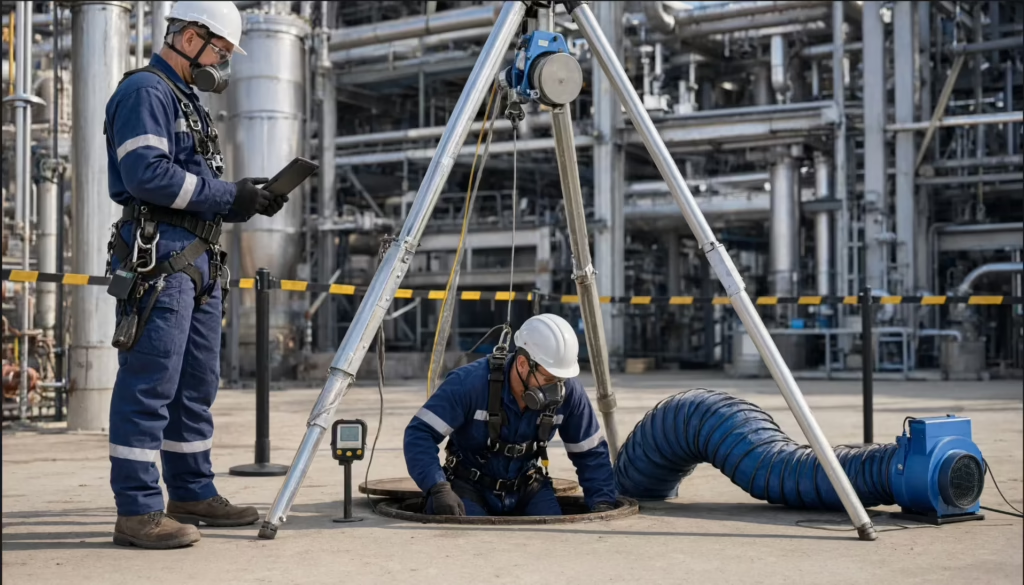
A crew walks the job, holds the briefing, fills out the form, and starts work. Everyone did their job. And research says they just identified fewer than half the hazards they will actually face that day.
Not because they were careless. Not because they needed another toolbox talk. Because of how the human brain works.
That finding is the strongest argument for AI hazard identification, and also the reason most conversations about it go wrong. If you do not know which hazards people miss and why, you cannot tell whether a product is solving that problem or just adding a camera to a form you already had.
What is AI hazard identification?
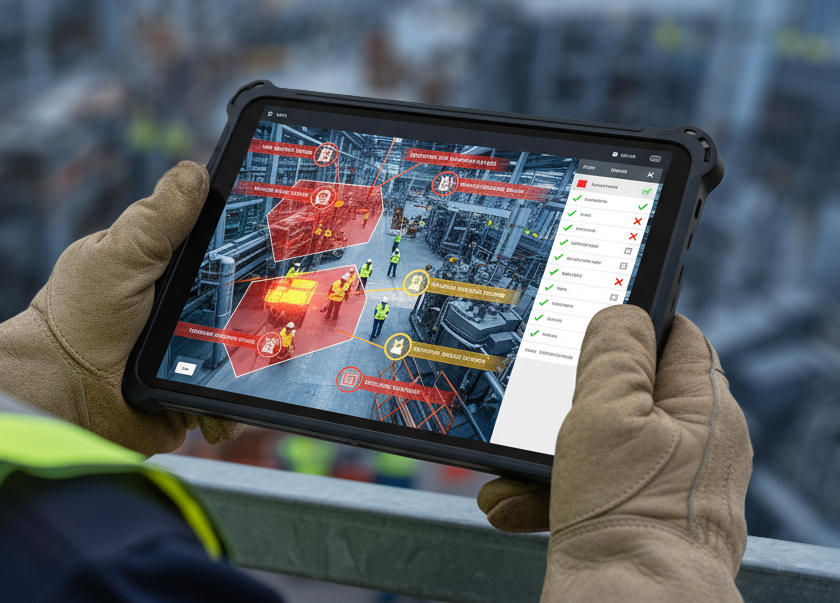
AI hazard identification is the use of machine learning to help workers recognize hazards at the point of work. In practice it means analyzing a photo of a work area to suggest hazards present, prompting for risk categories a crew has not mentioned, structuring what a worker says into a usable record, and finding patterns across many jobs that no single supervisor could see.
The important word in that definition is help. Everything below turns on it.
The 45 percent problem
Hazard recognition sounds like a soft skill. It has actually been measured, repeatedly, and the results should bother you.
Albert, Hallowell and Kleiner measured hazard recognition by comparing the hazards a crew identifies before work against the hazards they actually encounter during it. Across 4,800 worker-hours of field observation spanning 12 construction trades, average hazard recognition was approximately 45 percent. Crews identify and discuss less than half of what they face.
The breakdown matters more than the headline. Of the hazards present, about 45 percent get identified. About 35 percent are missed because of cognitive blind spots. The remaining 20 percent are not reasonably identifiable before work starts, because they emerge from change: a subcontractor staging material overhead, a design error, weather.
That middle number is the one you can do something about. And hazard recognition is not a minor contributor. It has emerged as a root cause in roughly half of all incidents.
The blind spot is predictable, which is the good news
Here is the part that reframes the whole problem. Workers do not miss hazards randomly. They miss the same ones, in the same order, everywhere.
In a study of 563 construction workers across 23 trades, with experience ranging from zero to 43 years, researchers found no meaningful difference in hazard recognition between trades and no correlation with years of experience. Twenty years on the job did not help.
What predicted recognition was the type of energy involved. Gravity and motion hazards get caught almost universally. A suspended load was identified by 100 percent of participants. Trip hazards, 98 percent. Uncapped rebar, 78 percent.
Then it falls off a cliff. Power lines, 65 percent. Welding heat, 35 percent. Cable tension, 23 percent. A pressurized canister, 8 percent. A hot saw blade, 2 percent.
Brain imaging research using functional near-infrared spectroscopy explains why. Gravity and motion hazards are processed instinctively in the amygdala, fast and with very little cognitive effort. That is the fight-or-flight machinery. Stand someone at a 50-foot edge and their body tells them before their brain does.
Hazards involving mechanical energy, pressure, chemical, and temperature get processed in the temporal lobe of the cerebrum, the region handling memory, sequencing, and complex problem solving. They take longer and cost more mental energy. Put someone at the bottom of a 20-foot unshored trench and nothing in their body screams, even though the exposure is just as fatal.
So the crew standing in that trench is not complacent. They are running the hardware they were issued.
This is why “pay more attention” fails as an intervention, and why the target for AI hazard identification is so specific. You are not trying to replace worker judgment. Worker judgment is catching the instinctive half. You are trying to cover a known, predictable, biological blind spot in the other half.
What AI hazard identification actually does
Judge these by outcome rather than by feature name.
- Sees what the eye skipped. A photo of the work area returns candidate hazards, including the low-salience ones people reliably miss. The worker confirms or rejects each.
- Prompts for what was not mentioned. The crew names five hazards. The system notices nothing was said about stored energy or temperature and asks. This is the highest-value function in the whole category and the least demoed.
- Structures what people say. A worker talks through the job and the system turns it into a record, instead of the worker translating their own knowledge into a form’s categories.
- Finds recurrence. Across hundreds of briefings, the same control keeps failing on the same task. No supervisor sees that from where they stand.
- Flags change. Twenty percent of hazards are not identifiable before work starts. Something that makes re-scanning cheap during the job addresses a gap no pre-job form can.
The benchmark nobody will show you: a laminated card
Now the uncomfortable part, and the question I would open every vendor conversation with.
The energy wheel is a card with ten icons on it, one per type of hazardous energy: gravity, motion, mechanical, electrical, sound, pressure, temperature, chemical, radiation, biological. Crews use it during briefings as a prompt to scan for categories that do not come to mind on their own.
It is one of the few safety interventions to undergo independent, controlled experimental testing on active work sites, using multiple baseline designs with randomized, staggered intervention timing and interrupted time-series regression. It improves hazard recognition by approximately 30 percent. Thirty percent, from a piece of laminated cardstock, with a study design strong enough to isolate the effect.
I sell AI hazard identification software, and I am telling you the card has better evidence behind it than any AI hazard detection product on the market today, including mine. No serious vendor can currently show you a controlled field experiment demonstrating their model improves hazard recognition by a measured amount.
So the buying question is not “does your AI find hazards.” Of course it finds hazards. The question is: does it beat the card, and how would we know?
That is a fair question and you should ask it. Here is the honest case for why software can still be the better answer.
The card works by making the crew stop and work through ten categories. That is cognitive effort, deliberately applied, which is exactly the point. It is also friction, every briefing, forever, on top of paperwork the crew already resents. In the field the card gets used enthusiastically for about six weeks after the training. Then it lives in the truck door.
The argument for AI is not that it is smarter than the energy wheel. It is that it can deliver the same prompting without asking the crew to carry the cognitive load, on a device already in their hand, in the time they actually have. The intervention that gets used at week fifty beats the better intervention that gets used at week six.
That is an adoption argument, not an intelligence argument. Be suspicious of anyone selling you the intelligence argument.
Related Read: Best Job Hazard Analysis Software
Where the evidence on AI actually stands
A 2026 systematic review in Safety examined 148 peer-reviewed articles published between 2013 and 2025, following PRISMA methodology. It found research heavily concentrated on vision-based monitoring, predictive hazard detection, and automated risk assessment, with organizational and governance questions comparatively unexplored.
The recurring barriers it identified are worth reading twice: data quality limitations, algorithmic opacity, fragmented digital ecosystems, and organizational resistance. The review characterizes these as persistent non-technical constraints on implementation.
Read that as a buyer. The literature’s own summary of why this technology struggles is mostly about data, explainability, integration, and people. Not model accuracy. Which means if you are evaluating AI hazard identification on detection benchmarks, you are evaluating the part that is not the problem.
Related Read:
- Risk Identification & Hazard Assessment Guide
- 7 Hazard Identification Examples in Utilities and Construction
How to evaluate it
Make them demonstrate, not describe.
- Photograph a real hazard your crews actually miss. Not a mannequin without a hard hat. Cable under tension. An unshored trench face. A pressurized line. If the product only reliably catches gravity and motion, it is confirming what your crew already saw and adding nothing.
- Check whether it prompts for absence. Have someone complete a briefing that deliberately omits stored energy. Does the system notice what is not there? Detection is easy. Noticing an omission is the valuable part.
- Make it wrong on purpose. Show it something ambiguous. Watch how it presents a low-confidence guess. A product that states a bad guess with the same confidence as a good one will train your crews to either ignore it or trust it blindly, and both are worse than nothing.
- Time it with gloves on. Outdoors, one-handed, on the phone the crew actually carries.
- Kill the connection. Then reconnect and confirm nothing was lost.
Questions worth asking:
- What hazard types is your model weakest on? A vendor who says “none” has not measured.
- What is your false positive rate, and what happens to crew trust when it is noisy?
- How does a worker override the AI, and is the override recorded?
- Who is accountable for the final hazard assessment, in your product’s design?
- Show me evidence beyond your own customer testimonials.
- What did you learn from a deployment that went badly?
Related reads: Job Safety Analysis Template · AI in Safety Management · Near Miss Reporting
The line that cannot move
AI suggests. The crew decides.
The system can propose a hazard, score a risk, and recommend a control from the hierarchy of controls. A person confirms it. The worker at the job owns the final assessment, because they are the one who can see the thing the camera did not, and they are the one exposed if it is wrong.
Any product that positions AI as the authority rather than the prompt has created a new failure mode while claiming to close an old one. My own view, and I would flag it as a view rather than a finding, is that a crew which learns to trust the model will stop scanning independently, and the day the model misses something is the day nobody else was looking either.
The right mental model is the one the hazard recognition researchers recommend for the energy wheel: use instinct first, then the tool. Workers reliably catch about half the hazards on their own. Let them. Then bring in the prompt for the categories biology tends to skip.
Where Field1st fits
We built HazardID around this specific problem: photo to candidate hazards, risk scoring, controls mapped to the hierarchy of controls, and a person confirming every one. The Missing Hazard Checker exists because prompting for what was not said is more valuable than detecting what was.
We cannot show you a controlled field experiment proving a percentage improvement. Nobody can yet. What we can show you is what a crew actually does with it in the two minutes they have.
See HazardID on one of your own jobs
Bring one form your crews fill out today and watch it come alive in 20 minutes. See where AI prompts for the hazards your people reliably miss, with a person confirming every one. No slides, no prep, no pressure.
The takeaway
Your crews are catching about half the hazards, they are missing the same half everyone misses, and the reason is neurological rather than attitudinal. That is a solvable, well-defined problem.
AI hazard identification is a reasonable tool for it, as long as you buy it for the right reason. Not because the model is impressive. Because it puts a prompt in front of a worker at the moment it matters, in a form they will actually use, covering the gap their instincts do not.
Evaluate it on the hazards your people miss, not the ones they already see.
Jyot Singh is the CEO of Field1st, an AI-native safety management platform built for field operations in high-hazard industries.
Sources
- Hallowell, M.R., “The Art & Science of Energy-Based Hazard Recognition,” Professional Safety, December 2021. Link
- Albert, A., Hallowell, M.R., Skaggs, M., and Kleiner, B., “Empirical measurement and improvement of hazard recognition skill,” Safety Science, 93, 1–8, 2017. Link
- Albert, A., Hallowell, M.R., and Kleiner, B.M., “Enhancing construction hazard recognition and communication with energy-based cognitive mnemonics and a safety meeting maturity model: Multiple baseline study,” Journal of Construction Engineering and Management, 2014. Link
- Hu, M., Shealy, T., Hallowell, M., and Hardison, D., “Advancing construction hazard recognition through neuroscience: Measuring cognitive response to hazards using functional near infrared spectroscopy,” Construction Research Congress, 2018. Link
- Musonda, I., “Artificial Intelligence in Construction Health and Safety: Use Cases, Benefits and Barriers,” Safety, 12(1), 30, February 2026. Link
- NIOSH, Hierarchy of Controls. Link