Workplace safety is no longer just a compliance checkbox—it’s a business-critical function that impacts everything from insurance premiums to employee morale to operational uptime. In industries like construction, manufacturing, logistics, and energy, managing safety manually is a high-risk, low-reward strategy. That’s why more organizations are turning to health and safety management software to gain control, stay compliant, and build a proactive safety culture.
In 2026, the demand for smart, scalable health and safety software is higher than ever. And the reason is simple: compliance standards are getting stricter, job sites are getting more complex, and reactive safety practices just don’t cut it anymore.
Our point of view: Health and safety management software does not improve safety by default. If crews cannot report hazards, near misses, JSAs, and inspections quickly from the field, the platform becomes a system of record after the fact, not a system that helps you intervene before an injury or downtime event. That is the lens we use throughout this guide.
In this comparison, we walk through the top 5 health and safety management software platforms for 2026. Whether you’re an HSE leader evaluating leading indicators, a project safety manager trying to improve crew participation, or an operations leader looking for faster investigations and less downtime, this guide will help you compare platforms built for modern field safety.
What Is Health and Safety Management Software?
Entity definition: Health and safety management software is a digital platform that centralizes workplace safety activities — incident and near-miss reporting, risk assessments, inspections, audits, corrective and preventive actions (CAPA), training records, and regulatory compliance — into a single system. It operationalizes occupational health and safety (OSH) management frameworks such as ISO 45001 and ANSI/ASSP Z10 by supporting the Plan-Do-Check-Act cycle: planning controls, doing the work safely, checking performance through data, and acting on findings to continuously improve.
Where paper forms and spreadsheets create fragmented, delayed records, modern platforms connect field activity to decision-making. They map directly to established safety practice — the Hierarchy of Controls for hazard mitigation, the OSHA Recordkeeping Rule (29 CFR 1904) for 300/300A/301 logs, and leading-indicator tracking championed by bodies like NIOSH and the National Safety Council (NSC).
Key Features to Look for in Health and Safety Management Software
1. Automated Compliance Tracking
Staying on top of OSHA, ISO 45001, and local regulations manually is a nightmare. Great software automates reminders, tracks document expiration, and provides digital logs for instant audit readiness. Compliance checklists and expiration notifications reduce administrative burden and missed deadlines.
2. Incident & Risk Reporting
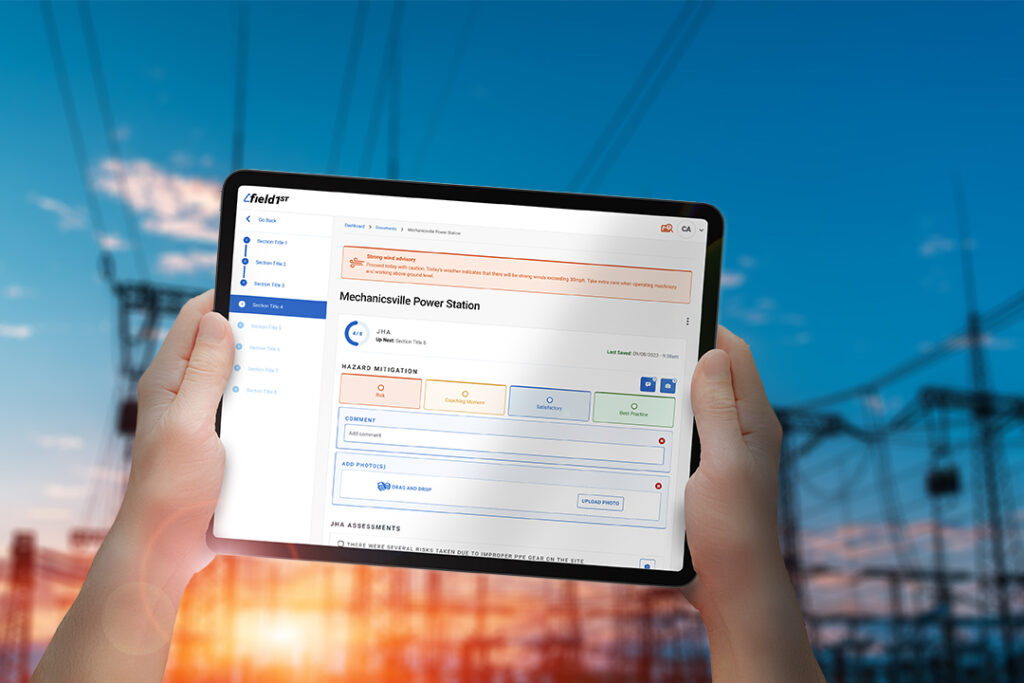
Every second counts when an incident occurs. Software should support real-time logging (from mobile or desktop), categorize incidents, assign follow-up actions, and track resolution. Some platforms also include photo capture, geolocation, and automatic severity scoring.
3. Safety Audit Management
Look for tools that offer digital audit checklists, scheduling, real-time scoring, and corrective action tracking. Bonus if it integrates with field teams and can be used offline. Scheduled and ad-hoc inspections can dramatically reduce risk exposure.
4. Employee Training & Safety Protocols
Ensure your platform lets you track who’s trained, what training is expiring, and what protocols are in place by location or team. Some advanced systems even include built-in LMS (Learning Management System) integrations or digital badge tracking.
5. AI & Predictive Analytics
The best systems don’t just log what happened—they help prevent what’s next. Predictive analytics can identify patterns and flag high-risk behaviors or sites before they become serious.
6. Mobile Accessibility & Cloud Integration
Field teams need to capture data on the go. Cloud-based, mobile-first platforms allow real-time collaboration and syncing across departments. Offline functionality ensures that safety protocols are still enforceable even in remote or underground environments.
7. Role-Based Access and Security Controls
Protecting sensitive safety data is essential. Platforms should include role-based access, user-level permissions, and secure audit trails for every action taken inside the system. This is especially critical in enterprise or union environments.
Top 5 Health and Safety Management Software in 2026
How we evaluated these platforms: We reviewed each platform based on field usability, AI capabilities, reporting workflows, compliance support, configurability, real-time visibility, implementation fit, and suitability for high-risk, multi-site operations. Comparison is based on publicly available product information, vendor documentation, third-party review platforms, and Field1st analysis as of January 2026. Capabilities may vary by package, configuration, and implementation.
| Dimension | Field1st | VelocityEHS | Intelex | Cority | Benchmark Gensuite |
|---|---|---|---|---|---|
| Primary functionality | Field-first Safety Operations Platform that turns field data into real-time safety intelligence across reporting, hazard detection, workflows, analytics, and compliance | Enterprise EHS, chemical management, ergonomics, ESG & compliance | Enterprise EHSQ, ESG, compliance & risk management | Enterprise EHS, occupational health, environmental & sustainability management | Enterprise EHS, compliance, risk, sustainability & operational excellence |
| Integration | API and enterprise integration options (Procore, ERP, HRIS, LMS); confirm available integrations during demo | API, SSO, ERP & enterprise system integrations | Open API & integration framework for ERP, SSO & business systems | RESTful API, EMR/EHR & third-party enterprise integrations | Platform APIs, Power BI & Tableau, IoT & enterprise data integrations |
| Customization | Highly configurable workflows, forms, templates & dashboards by site, contractor, or project | Configurable workflows, forms, dashboards & reporting | Highly configurable workflows, forms, dashboards & no-code app builder | Configurable workflows, dashboards, forms & no-code configuration | Configurable applications, workflows, dashboards & no-code configuration |
| AI features | AI Safety Agent for OSHA-aligned and company policy-based guidance, Voice1st form completion, photo-based hazard detection, suggested controls & predictive risk insights | VelocityAI insights, Vēlo AI assistant & AI-powered ergonomics analysis | Input AI & Insight AI for predictive risk analytics & regulatory parsing | Cortex AI agents, predictive analytics & automated risk detection | Genny AI, computer vision, IoT insights & predictive analytics |
| Real-time assistance | Mobile and voice capture, photo-based hazard review, real-time alerts, corrective action routing & field-to-leadership visibility | Mobile inspections, offline access, alerts & real-time dashboards | Mobile reporting, offline access, automated workflows & real-time dashboards | Mobile reporting, offline access, alerts & real-time risk visibility | Mobile inspections, real-time reporting, alerts & workflow automation |
| Customer Service | Guided implementation, onboarding & support for field adoption and scalable safety operations | Phone, email, knowledge base & enterprise support | Enterprise implementation, customer success & technical support | 24/7 support, onboarding, training & global customer success | Dedicated customer success, implementation services & enterprise support |
| G2 / Capterra rating | Not yet available — early-stage listing; verify on G2/Capterra at time of evaluation | 4.3/5 (G2, 100+ reviews) | 4.2/5 (G2, 90+ reviews) | 4.3/5 (G2, 70+ reviews) | 4.4/5 (G2, 60+ reviews) |
| Free trial / demo | Demo available; request a demo for package details | Quote-based; demo on request | Quote-based; demo on request | Quote-based; demo on request | Quote-based; demo on request |
| Pricing | Custom pricing; request a demo for package and implementation details | Custom enterprise pricing (quote-based) | Custom enterprise pricing (quote-based) | Custom enterprise pricing (quote-based) | Custom enterprise pricing (quote-based) |
Field1st vs. the Competition
See the Head-to-Head Breakdown
Want to see exactly how we stack up feature-for-feature against the competition? Check out our dedicated Field1st Comparison Page.
Note: Third-party ratings are directional and vary by source and date. Confirm current scores on G2, Capterra, and Gartner Peer Insights during your evaluation.
Field-first vs. enterprise-first: Many enterprise EHS platforms are built around centralized administration and compliance workflows. Field1st is built from the field up. That difference matters when adoption, reporting quality, and real-time visibility determine whether safety leaders can act before risk escalates. As you read the sections below, weigh not just feature breadth but whether crews and contractors will actually use the system day to day.
1. Field1st
Field1st is built for safety and operations teams that need better field inputs, faster visibility, and proactive risk control across crews, contractors, and job sites. The platform combines voice-enabled reporting, photo-based hazard detection, AI-assisted guidance, configurable workflows, and real-time analytics to help teams move from reactive oversight to proactive safety leadership.
Instead of separating JSAs, observations, inspections, incidents, photos, corrective actions, and analytics across multiple systems, Field1st creates a single source of safety truth. Field teams capture better data in the flow of work, while safety and operations leaders gain the visibility needed to prioritize action before risk escalates.
Best for
Utilities, utility contractors, heavy civil construction teams, and field-based organizations that want to improve adoption, standardize safety reporting, and move from reactive oversight to proactive safety leadership.
Core capabilities
- Voice1st reporting for JSAs, inspections, observations, near misses, and incident reports
- Photo-based hazard detection with suggested controls mapped to the Hierarchy of Controls
- AI Safety Agent for OSHA-aligned and company policy-based guidance
- Configurable forms and workflows by site, contractor, or project
- Corrective action tracking and closeout workflows
- Real-time dashboards and leading indicator visibility (observations, near misses, TRIR, DART)
What sets Field1st apart
Field1st does not just digitize safety forms. It helps teams capture better inputs from the field and turn them into real-time safety intelligence, giving leaders a single source of truth for risk, actions, and performance. Voice1st reporting converts field conversations into structured form data, and photo-based hazard detection identifies potential risks in jobsite images and recommends controls for review. Crews report faster, managers see risk earlier, and teams act before incidents occur.
Considerations
- As a newer, field-first platform, Field1st is purpose-built for high-risk field operations rather than broad enterprise environmental/ESG suites — organizations needing deep chemical inventory or sustainability reporting should confirm scope during a demo.
Request a Demo to see how Field1st supports field-first reporting, hazard detection, and real-time safety visibility.
2. VelocityEHS
VelocityEHS delivers a broad environmental health and safety management platform with strong depth in environmental and industrial hygiene, including chemical safety and SDS/HazCom management.
Best for
Organizations with heavy environmental and chemical compliance needs.
Core capabilities
- Incident management and inspections
- SDS and chemical management aligned with OSHA’s Hazard Communication Standard
- Industrial hygiene and exposure tracking
- Ergonomics program support
Strengths
- Deep chemical and hazardous materials management, valuable for manufacturing, labs, and oil and gas
- Mature compliance content library and regulatory coverage
Considerations
- Field workflows often rely on structured data entry, which can slow reporting for crews
- Real-time, field-driven insights are more limited than newer field-first platforms, so field-heavy teams should confirm mobile adoption during evaluation
Rated 4.3/5 on G2 across 100+ reviews. VelocityEHS works well when compliance depth is a priority, though it may require more effort to drive fast, consistent field engagement.
3. Intelex
Intelex offers highly configurable health and safety management software built for large, complex organizations that need process control and document management.
Best for
Enterprises that need deep customization and process control.
Core capabilities
- Incident tracking and root cause analysis
- Audits, inspections, and compliance workflows
- Document control and training management
Strengths
- Extensive configurability and no-code app building for bespoke workflows
- Strong document control, useful for regulated industries
Considerations
- For field-heavy teams, highly configurable enterprise systems may require additional setup to keep daily reporting fast, simple, and consistent for supervisors and crews
- Larger deployments can take time to configure and optimize
Rated 4.1/5 on G2 across 60+ reviews. Intelex gives organizations control over how their system works and supports consistency at scale, though it may take more time to optimize for day-to-day field use.
4. Cority
Cority connects health, safety, and environmental data into a single enterprise platform, with added support for occupational health and ESG reporting.
Best for
Organizations aligning EHS with sustainability and corporate reporting.
Core capabilities
- Occupational health and medical surveillance
- Environmental reporting and compliance
- Incident and risk management
Strengths
- Strong occupational health and medical surveillance modules
- Robust ESG and sustainability reporting for enterprise governance
Considerations
- The depth of features can create a steeper learning curve for new users
- Field adoption may require training to ensure consistent use across dispersed crews
Rated 4.0/5 on G2 across 80+ reviews. Cority helps organizations manage EHS alongside broader business goals with strong reporting and visibility, though teams may need time to fully adopt the system in the field.
5. Benchmark Gensuite
Benchmark Gensuite provides a modular health and safety software solution designed for scalability and standardization across sites.
Best for
Organizations focused on consistency across multiple sites.
Core capabilities
- Incident management and reporting
- Inspections, audits, and risk assessments
- Compliance tracking and corrective actions
Strengths
- Broad modular library covering many EHS and operational excellence use cases
- Strong at standardizing repeatable processes enterprise-wide
Considerations
- Teams that need fast field-to-leadership visibility should confirm how real-time hazard, near-miss, and corrective action data will surface across crews and sites
- Advanced features may require additional modules to unlock full value
Rated 4.0/5 on G2 across 10+ reviews. Benchmark Gensuite helps organizations build structured, repeatable processes and supports consistency and compliance, though it may not deliver the same level of real-time field visibility as field-first platforms.
Also Worth Considering
Buyers evaluating a broader shortlist may also weigh these established platforms:
- SafetyCulture — a widely used mobile inspections and frontline operations platform, strong for checklists and field audits.
- EcoOnline — an EHS and chemical safety vendor with deep roots in compliance and chemical management.
- Enablon (Wolters Kluwer) — an enterprise EHS and ESG platform common in large-company evaluations.
- Sphera — an EHS, process safety, and operational risk provider for enterprise-first environments.
- Evotix — a safety management platform focused on engagement and frontline participation.
For heavy-industry buyers, our Top 5 Mining Safety Management System Providers in 2026 covers vertical-specific options in more depth.
Key Trends Shaping Health and Safety Software in 2026
Health and safety software is shifting toward systems that connect data, workflows, and teams in one place. Companies no longer want isolated tools. They want a clear view of performance across safety, health, and environmental programs.
Leading indicators are becoming the standard
More organizations now track what prevents incidents, not just what happens after. OSHA supports this approach in its guidance on leading indicators and program evaluation, highlighting inspections, observations, and corrective actions as key measures of program strength. These metrics help teams see gaps early and act before risk builds.
AI is helping teams act on safety data faster
Safety teams collect large amounts of data, but it only matters if they can use it. Many platforms now analyze that data to spot patterns, flag risks, and guide decisions — aligning with OSHA’s focus on using recordkeeping data to identify hazards and prevent future incidents.
Cross-site consistency is now a core requirement
As organizations grow, safety programs often drift across locations. Modern systems help standardize inspections, reporting, and training across sites, supporting OSHA’s recommended safety management practices and system-based standards like ANSI/ASSP Z10.
Environmental and safety data are coming together
Safety and environmental work now overlap more than ever. Companies must manage chemical inventories, SDSs, and reporting alongside core safety tasks. These requirements come from OSHA’s Hazard Communication Standard and EPA programs like hazardous chemical inventory reporting and the hazardous waste manifest system.
Field-first usability is becoming the foundation of safety intelligence
Safety programs only work when people use them. If tools slow crews down, reporting drops and risk increases. This is where the quality of inputs matters. A system that looks strong in the office can still fail in the field if supervisors and crews do not use it consistently. Voice-enabled reporting, mobile capture, photo documentation, and simplified workflows help close the adoption gap that often limits traditional EHS systems — supporting OSHA requirements for employee involvement under 29 CFR 1904.35. Methodologies such as Human and Organizational Performance (HOP), widely adopted in utilities and energy, reinforce that better inputs and blame-free reporting drive better outcomes.
How to Choose the Right Health and Safety Software
Choosing the right health and safety software solution starts with how your organization manages EHS today. The goal isn’t just to digitize tasks, it’s to bring safety, health, and environmental work into one connected system that teams can actually use. Because AI, leading indicators, and field usability are becoming standard expectations, prioritize vendors that already excel in these areas rather than treating them as optional add-ons.
Look for platforms that support the full picture, not just one piece of it:
- Centralize safety, health, and environmental data in one place
- Align workflows across sites, teams, and contractors
- Track both leading and lagging indicators
- Connect training, reporting, and compliance activities
- Make it easy for field teams to participate
- Fit your industry’s unique risks, whether that’s real-time job site inspections in construction, lockout/tagout in manufacturing, or hazmat tracking in oil and gas
Don’t settle for just another software vendor. Choose a partner that understands the evolving landscape of safety, compliance, and operational excellence, and one built with your world in mind. The more tailored the tool, the less friction you’ll face during implementation.
Which Health and Safety Management Software Is Right for You?
Choosing the right platform ultimately depends on your organization’s priorities. Some solutions are built for AI-driven field operations, while others focus on enterprise compliance, environmental management, or highly configurable workflows. Use the table below to quickly identify which platform best aligns with your safety goals.
| If your priority is… | Recommended Software | Why it’s a strong fit |
|---|---|---|
| AI-powered incident prevention and field safety | Field1st | AI-driven hazard detection, predictive analytics, voice-powered reporting, and real-time field intelligence. |
| Environmental compliance and chemical management | VelocityEHS | Strong capabilities for SDS management, industrial hygiene, ergonomics, and environmental compliance. |
| Highly configurable enterprise workflows | Intelex | Extensive customization, workflow automation, and process control for large organizations. |
| Occupational health, ESG, and sustainability | Cority | Combines health, safety, environmental, and ESG management within one enterprise platform. |
| Standardizing safety programs across multiple sites | Benchmark Gensuite | Modular platform designed for enterprise-wide consistency, governance, and compliance. |
Ultimately, the best platform is the one that aligns with your operational complexity, regulatory requirements, and long-term safety goals.
Which Health and Safety Management Software Is Right for You?
Choosing the right platform ultimately depends on your organization’s priorities. Some solutions are built for AI-driven field operations, while others focus on enterprise compliance, environmental management, or highly configurable workflows. Use the table below to quickly identify which platform best aligns with your safety goals.
| If your priority is… | Recommended Software | Industries Best Suited | Why it’s a strong fit |
|---|---|---|---|
| Field-first reporting, AI-assisted hazard detection, and proactive safety visibility across crews and sites | Field1st | Utilities, utility contractors, heavy civil construction, infrastructure | Voice1st reporting, photo-based hazard detection, configurable workflows, corrective action tracking, and real-time dashboards help teams capture better field inputs and act faster on emerging risks. |
| Environmental compliance and chemical management | VelocityEHS | Manufacturing, oil & gas, labs, industrial | Strong SDS/HazCom, industrial hygiene, ergonomics, and environmental compliance. |
| Highly configurable enterprise workflows | Intelex | Large multi-industry enterprises | Extensive customization, workflow automation, and document control for complex organizations. |
| Occupational health, ESG, and sustainability | Cority | Enterprise, healthcare, energy | Combines health, safety, environmental, and ESG management in one platform. |
| Standardizing safety programs across multiple sites | Benchmark Gensuite | Multi-site enterprises, operational excellence programs | Modular platform designed for enterprise-wide consistency and governance. |
Ultimately, the best platform is the one that aligns with your operational complexity, regulatory requirements, and long-term safety goals.
Related Reading
- Construction Safety Plan: How to Create and Implement One That Works
- How to Get Field Crews to Report Near Misses Without Fear
- Top 5 Mining Safety Management System Providers in 2026
- How to Conduct a Health and Safety Audit – Step-by-Step Guide
Why Choose Field1st
Field1st is purpose-built for the field. Where enterprise-first EHS suites are architected around centralized administration and compliance archives, Field1st starts with the crews and contractors doing the work. That focus shows up where it counts: because the crews and contractors doing the work actually use it in the field, teams capture more observations, sustain higher participation, and get clearer visibility into the leading indicators that predict incidents — rather than compliance archives that fill up after the fact.
For utilities, utility contractors, and construction teams battling disconnected data — cited by 80% of leaders as a barrier to proactive risk management (Deloitte, July 2025) — Field1st’s single source of safety truth turns field reports, photos, forms, and corrective actions into intelligence leaders can act on before downtime or injury occurs.
Where Field1st is not the best fit: organizations whose primary need is deep chemical inventory management, medical surveillance, or enterprise ESG reporting may find specialized enterprise suites more complete for those specific modules. Match your must-haves to the platform, and validate scope in a demo.
Explore Field1st to learn how the platform supports field-first safety operations.
Final Thought
Safety isn’t just a policy—it’s a mindset, a system, and a competitive edge. Choosing the right software isn’t just about ticking boxes—it’s about building a workplace where everyone goes home safe, every single day.
Ready to future-proof your safety program? Book a Field1st demo today and take the first step toward safer, smarter worksites.
Health and Safety Management Software FAQs
1. What is health and safety management software?
Health and safety management software is a digital platform that helps organizations manage workplace safety, compliance, and reporting in one system. It is commonly used to track incidents, risks, audits, inspections, corrective actions, and compliance obligations, and to operationalize frameworks like ISO 45001 and ANSI/ASSP Z10.
2. What should field-based teams look for in safety software?
Field-based teams should prioritize mobile capture, offline access, voice reporting, photo documentation, configurable forms, corrective action tracking, and real-time dashboards that help leaders act on risk earlier. Adoption by crews and contractors is the single strongest predictor of data quality.
3. Why are leading indicators important in safety management?
Leading indicators such as inspections, observations, hazard reports, near misses, and corrective action closeout help teams identify risk before incidents occur. OSHA and ANSI/ASSP Z10 both emphasize proactive measures over lagging metrics like TRIR and DART alone.
4. How does AI support health and safety management?
AI can analyze safety data, identify patterns, surface emerging hazards, provide OSHA-aligned and company policy-based guidance, and help teams prioritize the highest-risk issues faster. Its value depends on complete, timely field inputs feeding the system.
5. What is the difference between health and safety software and EHS software?
Health and safety software usually focuses on workplace safety activities such as incidents, hazards, inspections, and corrective actions. EHS software is broader and often adds environmental and occupational health functions, chemical management, and ESG reporting.
6. What kind of organization benefits most from this software?
Multi-site, high-risk, and compliance-heavy organizations benefit most because they need centralized control over incidents, audits, contractor oversight, and safety records. Field-heavy businesses in utilities, construction, and infrastructure benefit especially when the system supports mobile-first reporting and fast inspections.